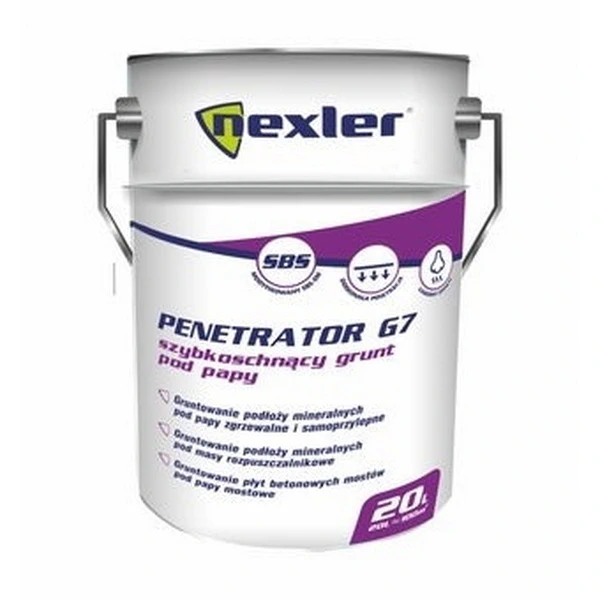
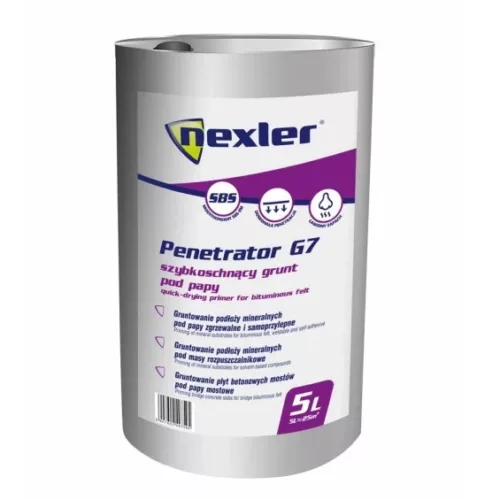
NEXLER Penetrator G7 – bituminous primer for self-adhesive membrane
NEXLER Penetrator G7 is a ready-to-use, fast-drying SBS-modified bituminous primer intended for bituminous self-adhesive and torch-on membranes and for solvent-based coatings on mineral substrates. Its role is to prepare the substrate for the next layer, not to replace the actual waterproofing coating. It is applied with a brush or broom, and substrate absorbency and ambient conditions affect consumption and drying time.
Continuity of priming for self-adhesive membrane
Priming for a self-adhesive membrane must be continuous across the entire surface, because any missed spot weakens the adhesion of the self-adhesive layer. NEXLER Penetrator G7 should be applied evenly, without gaps or puddles of excess, to prepare the substrate for the next layer. The next layer may be installed only after the primer has dried, not merely after the surface has set.
Spreading the primer evenly, with no misses and no excess, creates a continuous layer that reduces the risk of poor adhesion of the self-adhesive membrane in skipped areas.
Drying state before the next layer
The next layer is laid only after the primer has dried, not merely after surface setting, because a seemingly dry surface does not guarantee readiness to receive the next layer.
Drying time is affected by substrate absorbency and ambient conditions, so the drying state should be assessed on the actual condition of the layer rather than on the time elapsed since application alone.
Before covering an area, also inspect narrow strips at the edges and the points where the previous shift stopped work.
Releasing a section for the membrane
Mark the areas ready for the membrane and allow later applications of primer to dry. This helps coordinate the two crews.
If conditions change during the day, reassess the primed surface. The drying time in the technical data sheet is an approximate value.