Roof flashings: where they are used and what they do
Gutters and flashings
Metal flashings determine whether water from the roof ends up where it should, so when choosing them it is worth starting by checking how a given detail works with the covering and the layer build-up beneath it. The sheet alone will not close edges, changes of direction or penetrations through the slope. At the eaves and verges, the relative arrangement of components and their fixing are key, while at the valley and ridge it is the drainage path and ventilation. It is also worth establishing whether the shape and material match the actual roof section before ordering folding.
Why is the covering sheet alone not enough?
A large roof slope has a predictable direction of water runoff. Problems begin at its end, where the direction changes or where it passes through the roof. At these points a detail is needed that connects the surfaces and carries the water further. Flashings are therefore not a decorative addition. They often determine the effectiveness of the entire covering.
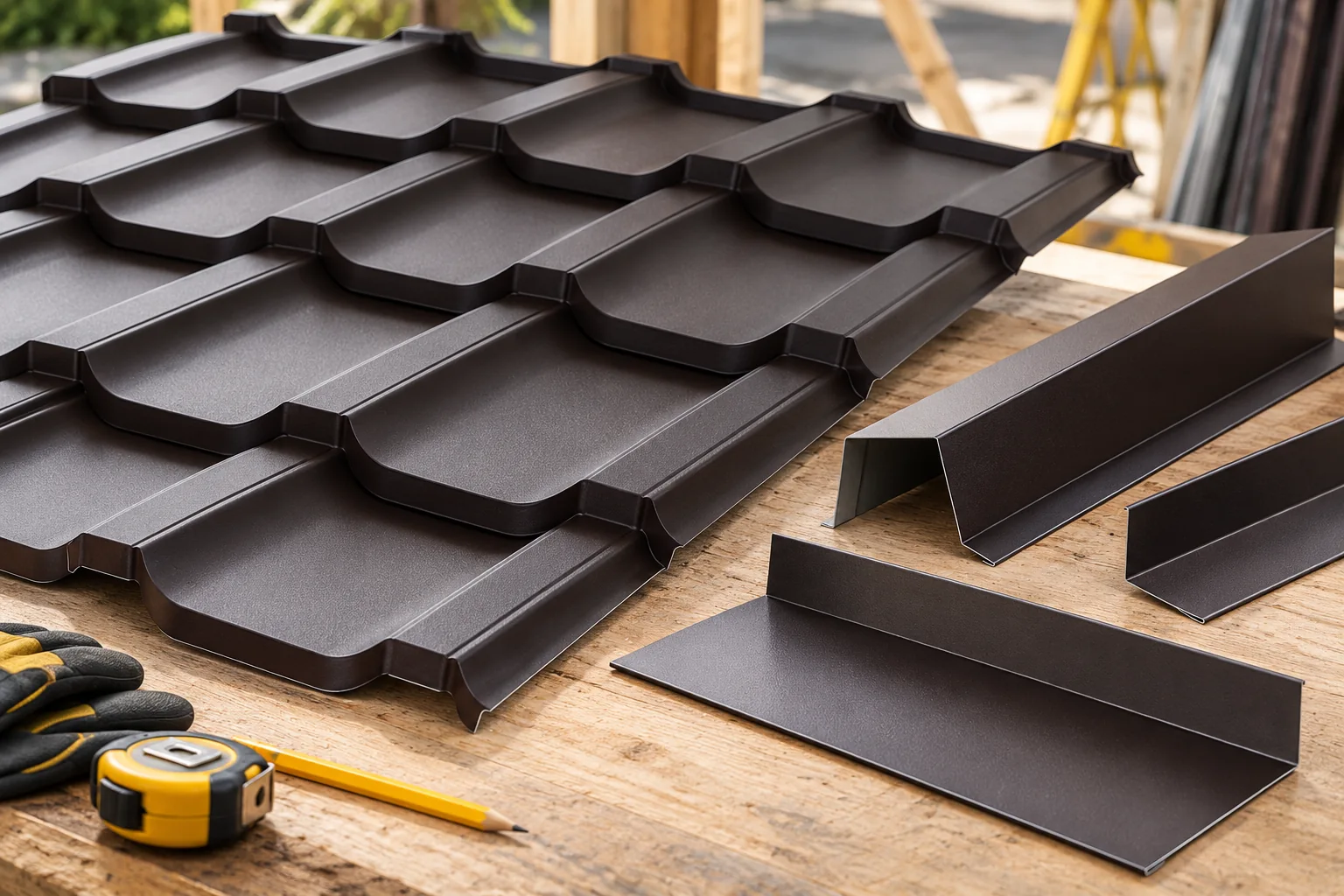
Trapezoidal steel sheet and tile-effect metal roofing have different shapes. The same angle profile will not close them correctly in every situation. A roof made of insulated sandwich panels also needs its own solutions. There the flashing works together with the core, the interlock and the seals, which must be protected from water and air flow.
What role do the strips at the eaves play?
At the eaves, water must be drained from the covering and from the underlay. Sheet metal strips direct it to the intended place and protect the timber elements. Their mutual arrangement depends on the system. The names found in offers vary, so it is worth also using a cross-section drawing.
The flashing must not block the air inlet under the covering. It should also not create a counter-slope where water would collect. Before installation, the position of the gutter, the first batten and the sheet edge is determined. Changing one of these elements may require adjusting the others. It is better to check this before ordering the bending.
What does the verge flashing protect?
The verge flashing finishes the side edge of the roof slope. It limits wind-driven precipitation and protects the edge of the covering. It must have proper laps and fixing. It is not enough to screw it down at a few convenient points. The edge zones of the roof can be heavily loaded by wind suction, which must be taken into account in the design.
Its width and height are selected to suit the actual cross-section. If too low, it will not cover the edge, while an excessively wide one may look heavy and wave. When joining long sections, thermal movement of the sheet metal must be allowed for. A straight finish line also results from a level substrate, not only from precise bending.

How do the roof valley and ridge flashing work?
The roof valley collects water from two roof slopes meeting at an internal angle. It needs a sufficiently wide drainage path and support. Its base should not be accidentally pierced by fixings. Sheets cut too tightly can restrict flow and trap leaves. An additional sealant will not solve such a problem.
The ridge covers the upper junction of the roof slopes. In a ventilated roof it must also allow air to escape. Suitable tapes or system components combine these two functions. Sealing the entire cross-section with foam can block ventilation. The choice of ridge must therefore be matched to the layer build-up beneath the covering.
What needs attention at the chimney and wall?
The junction between the roof and a masonry element moves under the influence of temperature and structural movement. The flashing should drain water on the outer side, and its upper edge requires protection. A strip of sealant on the render alone is usually not a complete detail. A durable bond to the substrate and the correct overlap are what matter.
Water or snow can accumulate behind the chimney. The solution for this zone depends on the chimney width and the roof pitch. During acceptance, also inspect the corners and the transition of the underlay. A leak visible at the ceiling may be the result of an error located higher up that cannot be seen from ground level.
Which sheet metal should the flashings be made from?
The material should match the covering and the environmental conditions. For coated steel, thickness, metallic protection and the organic coating all matter. Accidental mixing of metals can cause corrosion problems. Equally important is selecting sealants that will not damage the coatings and will remain flexible.
Cold-cutting tools are used for cutting. Swarf and drilling residues must be removed after installation. When ordering, specify the lengths, angles and developed width of each shape. A price per linear metre without the developed width does not allow a fair comparison of quotes. Two visually similar elements may use different amounts of sheet metal.
How to accept finished flashings?
Check the direction of the overlaps, the water drainage and the condition of the surface. Fixings should not deform the sheet metal or leave loose fragments. Pay attention to the ends and the points of contact with seals. A minor error at the corner can matter more than a perfectly straight middle section of a strip several metres long.
Keep drawings of non-standard elements in the documentation. They will be useful during repair or extension. Add fixings, tapes, support and the roofer’s labour to the cost estimate for the flashings. A well-prepared detail should drain water throughout its service life, not merely cover a gap on the day of acceptance.
7 branches. Materials closer to your project.