IKO enertherm ALU TG: documenting joints in building elements
PIR insulation
The ALU TG drawing must indicate where the factory joint ends. Cut-outs and offcuts can change the geometry of the edge. The specification should define how such locations are to be executed and at which stage they are to be inspected. The requirement to maintain continuity then becomes feasible to execute and to accept. The IKO enertherm ALU TG specification should identify the function that the thermal insulation joined with a factory tongue and groove is to perform. The element requiring an unambiguous description is the edge of an offcut without a preserved factory tongue. The input data should include the width of the last strip and the position of the lock terminations, and not only the area intended for thermal insulation. The coordinating document remains the row plan with the edges remaining after cutting marked.
In this article
Input data for the specification
It must be recorded who confirms the feasibility of carrying out the task: making joints between full boards and cut pieces without gaps in the layer. In this respect, the person responsible should be the ALU TG cutting and laying coordinator, in accordance with the division of design work.
The product itself and the scope of its data
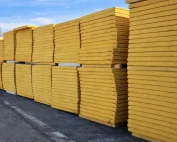
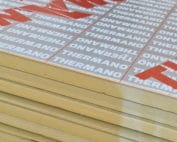
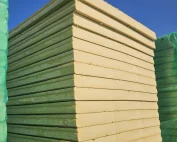
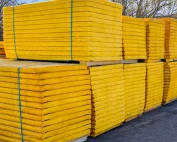
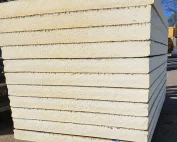
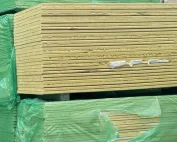
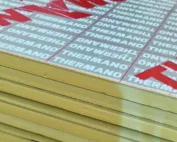
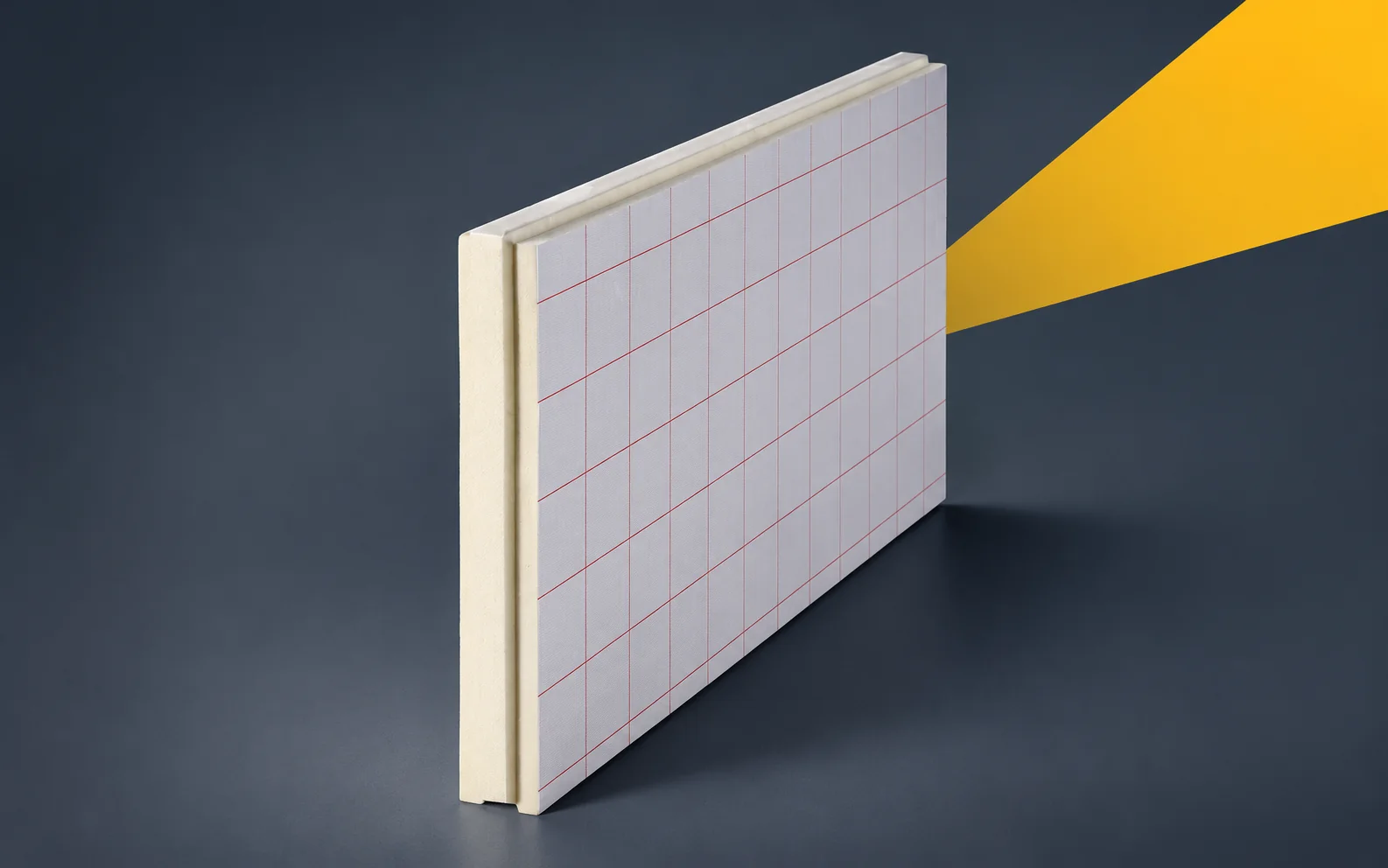
In the documentation for the IKO enertherm ALU TG building envelope, the product appears as a PIR board with an aluminium laminate whose edge is shaped as a tongue and groove. For the family, lambda 0.022 W/(m·K) and a compressive strength level of at least 175 kPa are given. The reaction to fire is F, while B-s2,d0 refers to a specific end use. The TG profile itself does not perform the function of a structural connection and does not replace waterproofing. Cutting means that a section of the edge no longer has its factory shape, which is why, in design and construction, IKO PIR boards are considered within the limits of thermal insulation joined with a factory tongue and groove. The core of the board in question is made of polyurethane foam of the PIR type, and the properties of the complete product also depend on the facings. Polyurethane insulation here means the laying of factory boards in a defined layer arrangement.
What the presented calculation covers
On the IKO enertherm ALU TG laying plan, mark where the factory tongue and groove will remain after cutting and where the perimeter termination must be resolved. For the thermal example, keep a separate record: 100 mm, lambda 0.022 W/(m·K), quotient 0.10/λ approximately 4.55 m²K/W. This is the result of a calculation, not the declared RD, whose value is specified in the product documentation. Delivery inspection therefore covers both the thermal data and the feasibility of the joints shown on the plan.
For IKO enertherm ALU TG, a distinction must be maintained between the product data and the result of the overall solution. The analysis uses the characteristic: tongue-and-groove profile in the ALU TG variant. The assessment must take into account the limitation: no factory profile on the edges after cutting. Before approving the variant, the places where the factory profile is lost must be indicated on the drawing and the result recorded in the documentation. Reproducing the assumptions is made possible by a row plan marking the edges remaining after cutting. As a result, a later comparison with another offer does not omit the element described as a cut edge without a preserved factory tongue and groove.
Conditions for assessing the variant
In the design, it is possible to compare the action described as changing the width of the first row for a more favourable final cut with the solution of retaining the full first row and resolving the perimeter separately. The criterion should stem from the need to make connections of full boards and cut pieces without gaps in the layer. For IKO enertherm ALU TG, retaining a single figure from the data sheet does not mean the entire cross-section is equivalent. The requirements must also take into account the tongue-and-groove profile with intact and matched edges. Treating every cut piece as an element with a complete factory joint must be excluded, because it changes the meaning of the recorded parameter. The decision should be presented by the coordinator for the cutting plan and laying of ALU TG, together with the scope of changes for adjacent materials. The adopted variant must be linked to the schedule: cutting plan with laying direction and termination details.
Description of how the important connection is made
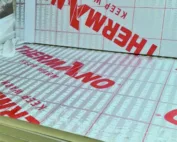
The drawing should unambiguously indicate the cut edge without a retained factory tongue. In the case of IKO enertherm ALU TG, the surface of the material formed by the aluminium laminate of the ALU TG variant must also be described. The preparation must provide a level substrate without forcing the joint into position by force. The required inspection point occurs before the stage described as the finish laid after acceptance of the connections. The basis for acceptance is the description of the tongue-to-groove fit and perimeter sealing, assigned to the drawing and the execution location. Such a description limits discretionary decisions by the crew at a point that will not be visible later.
Delivery and acceptance documents
The delivery of IKO enertherm ALU TG should be assignable to a single specification item. This item is expanded by the cutting plan with laying direction and termination details; every described feature should have a reference to the design. A description of the tongue-to-groove fit and perimeter sealing is needed, allowing the variant and its method of use to be confirmed. If conditions change, the absence of the factory profile on the edges after cutting must be reconsidered. The update should be agreed by the coordinator for the cutting plan and laying of ALU TG before the next layer conceals the discrepancy. In this way, the polyurethane insulation is linked to the executed scope, namely the thermal insulation joined with factory tongue and groove.
A record that can be checked later
The final description of IKO enertherm ALU TG should allow the adopted decision to be reproduced without guessing its purpose. In this case, the purpose can be defined as the need to make connections of full boards and cut pieces without gaps in the layer. The description should be accompanied by a row plan indicating the edges remaining after cutting. The cut edge without a retained factory tongue should be indicated separately where its solution differs from the main field. The record should cover the entire required scope. When proposing a substitute, the locations where the factory profile is lost must be indicated on the drawing again, instead of basing the assessment solely on the name PIR. Polyurethane boards are then compared according to verifiable features and effects on the specific cross-section.
7 branches. Materials closer to your project.