Choosing a flat roof covering and the layers beneath it
Choice of covering
A flat roof needs a considered layer build-up, not just a single decision about the covering. The building owner and the trade should check whether the structural base, moisture control, thermal insulation and waterproofing form a coherent system, and whether the roof plan shows outlets and high points. The choice of PIR variant depends on the declared lambda and its compatibility with the membrane, not on the material name alone. The fall and its execution must suit the chosen system, so the drainage plan is developed together with the cross-section.
Does a flat roof mean no fall?
The term “flat” describes the form of the roof, not a licence for accidental ponding. The building envelope should direct precipitation to the intended drains. The fall can be achieved through various design solutions. Its value and method of execution must correspond to the selected waterproofing system.
The drawing must indicate the outlets or edge drainage, as well as the higher and lower points. Parapets, penetrations and equipment are important. Adding another element to a finished roof can change the path of water. Therefore, the drainage plan should be developed together with the cross-section, not after the insulation has been laid.
What role can structural trapezoidal steel decking play?
A high trapezoidal profile is sometimes used as a load-bearing substrate for subsequent roof layers. It is selected according to span, loads and type of support. Tables are required for the specific thickness and steel grade. T18 or T35 should not automatically be treated as a replacement for every high structural profile.
Fastenings to supports and sheet connections must also be checked. Loads from people, installations and accumulated snow can occur on the roof. The load-bearing capacity of a single sheet is not the load-bearing capacity of the entire structure. The design also includes purlins, beams and support points for equipment.
What to choose for the waterproof layer?
Flat roofs use waterproofing systems selected according to the substrate, fall and intended use. The choice may include bituminous solutions or roof membranes. More important than the general name is the approval of the entire system, the method of fastening and the execution of joints.
The waterproof layer must work together with the insulation and the details at parapets and outlets. Not every PIR board facing is suitable for any adhesive bonding or welding. Material compatibility must be checked before purchase. Replacing one component without this check can change the operating conditions of the entire system.

When does PIR help reduce thickness?
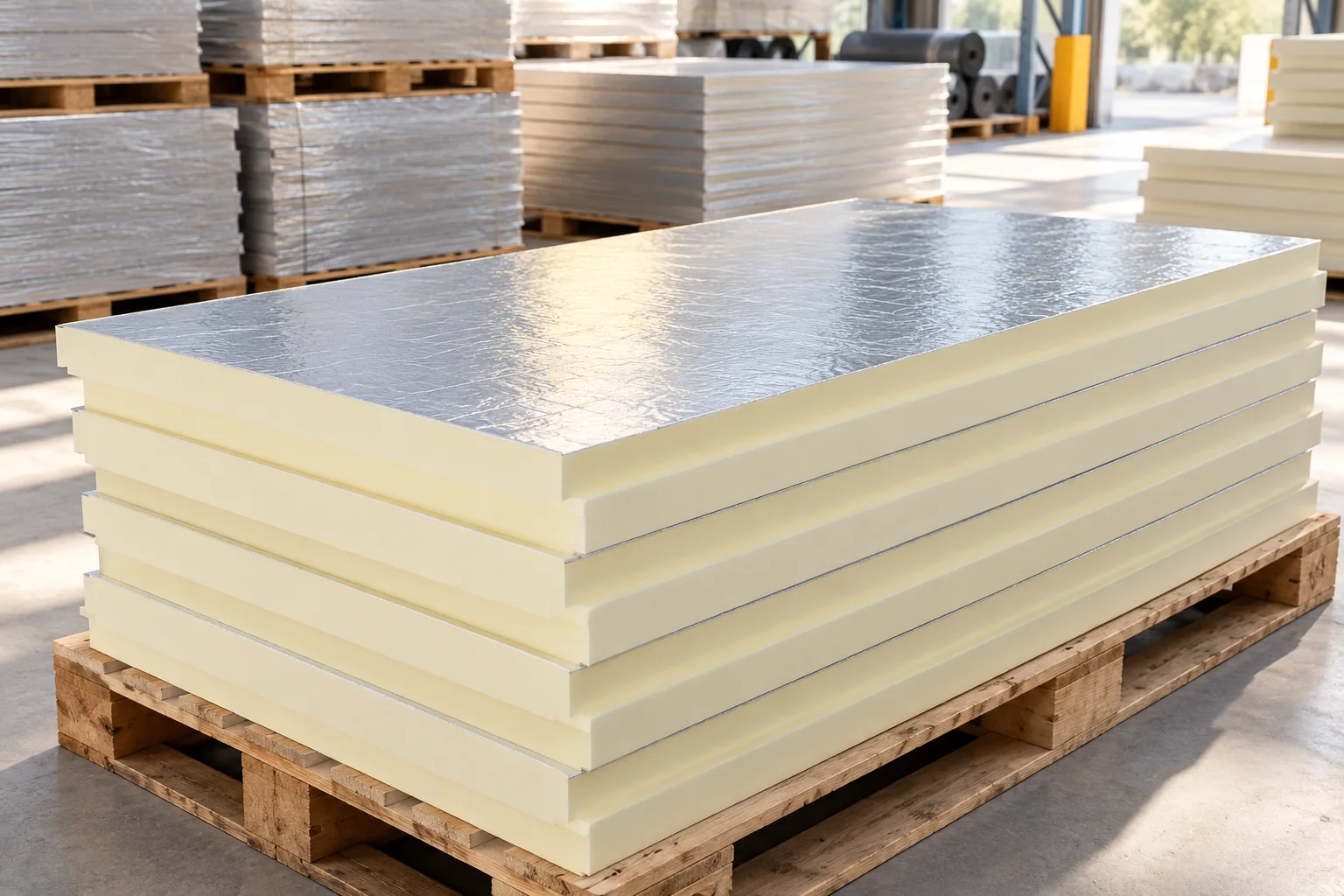
PIR is worth considering where good thermal performance is needed within a limited layer height. The declared lambda of the specific variant matters. Boards with different facings may have different parameters and intended uses. A single value should not be attributed to all products.
The example of the material layer alone is straightforward: at R equal to 5 m²K/W, PIR with a lambda of 0.022 requires 110 mm. For EPS with a lambda of 0.031, the result is 155 mm. This is the calculation d = R × lambda, not a ready-made U-value for the whole roof. Thermal bridges, junctions and the remaining layers require separate assessment.
When should other insulation materials be checked?
Fire and acoustic requirements may favour a mineral wool solution. For roofs with a different layer sequence or moisture conditions, appropriately approved XPS variants are considered. EPS is also available in variants for specific roof applications. The material abbreviation alone is not sufficient for selection.
Check the intended use, mechanical parameters and compatibility with the waterproofing. The stress at ten percent deformation is not simply the permissible permanent load. Equipment supports and maintenance routes may require additional solutions. A rigid board does not mean a roof for arbitrary loading.
How can moisture be prevented from becoming trapped?
The design should resolve the control of water vapour flow and air tightness. The conditions inside and the composition of the entire assembly matter. A PIR board with facing does not automatically replace every required seal. Junctions and service penetrations require particular attention.
Materials must be stored and installed under the conditions specified by the manufacturer. Moist layers must not be enclosed under the waterproofing. Transport packaging does not always provide protection during long storage on site. The schedule must also include protection in the event of a work interruption.
What should be included in the design and cost estimate?
Beyond the roof surface, count parapets, outlets, penetrations, fixings and flashings. Add maintenance routes and equipment supports. If photovoltaics are planned, the loads, mounting method and access to drainage must be assessed. Free surface area alone is not yet confirmation that an installation can be placed.
In the quote, require a description of the entire layer assembly and documentation of the products used. Define the scope of acceptance and the inspection rules after completion. A good flat roof results from the combination of load-bearing capacity, tightness and proper drainage. The most expensive membrane or the thickest PIR will not replace well-executed junctions.
7 branches. Materials closer to your project.