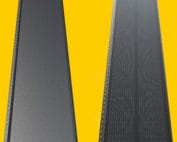
Solar roofing without a visible mounting frame above the roof
Roof and energy
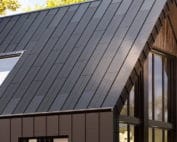
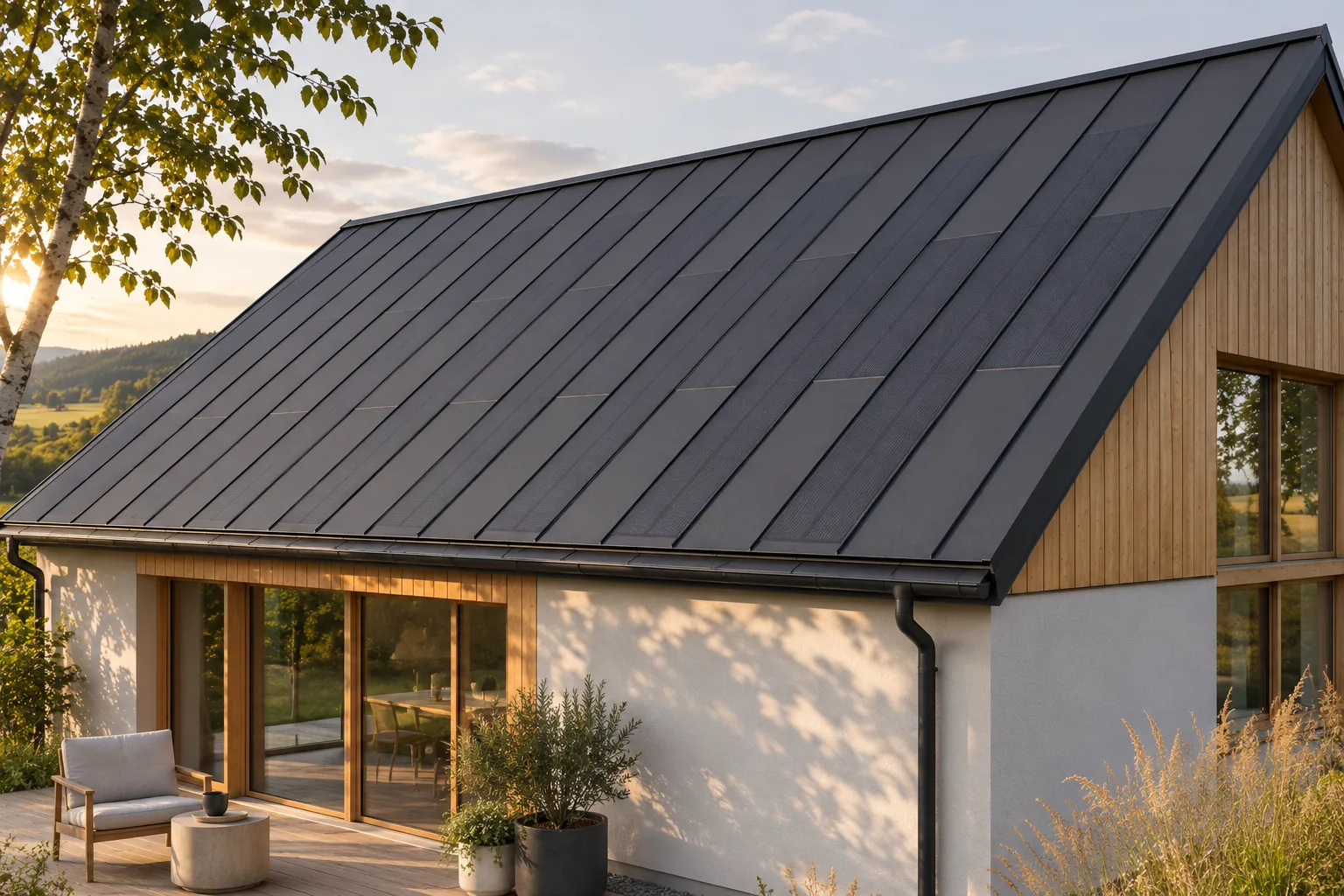
A roof that generates electricity without visible mounting above the roof surface is possible by integrating photovoltaics into the covering. In the steel variant, the cells are part of the roof panels, and passive elements complete the composition. There is no need to first cover the entire active area with ordinary material and then place modules above it. However, a complete system of structure, layers and fixings is still required. Integration means joining them properly. There is no separate structure holding standard modules above the finished covering. As a result, the roof surface keeps a more compact outline, and the installation does not look like an additional level. This is a significant benefit on a house with a simple form or on a roof clearly visible from the garden.
In this article
What exactly disappears from view?
The aesthetic effect results from combining functions within the system itself.
This does not mean dispensing with fixings and support. They must still transfer loads to the structure. The integrated components also have their own thickness, joints and edges. It is worth clearly distinguishing the absence of a raised mounting frame from a promise of a roof devoid of all technical parts.
How to recognise a truly integrated solution
It is best to look at the cross-section and ask which element performs the covering function. In BIPV, a given system replaces part of an ordinary roof or forms its outer layer. If a complete independent covering remains beneath the installation, the role of each element must be explained precisely. The low height of the modules alone does not determine the method of integration.
Various variants exist on the market. There are steel elements with cells, glass systems and solutions built into part of the roof slope. They can achieve a similar aesthetic goal by a different method. For the investor, construction, tightness and scope of works are important. Not all systems should be assessed solely on the basis of a photograph of a finished house.
Why decide this early?
At the design stage, it is easier to adapt the roof slope dimensions, window arrangement and installation routes. The cells then become a natural part of the architecture. A late decision may require changing the ordered material or adapting the structure. It is therefore advisable to combine the choice of BIPV with work on the entire roof rather than leaving it until the end of construction.
A similar principle applies to renovation. If the covering is going to be replaced anyway, the substrate for the chosen system can be prepared. This allows the shared scope of roofing and electrical works to be used better. It does not automatically give a lower price, but it makes it easier to compare complete variants and avoid unnecessary duplication of works.
How to maintain the visual continuity of the roof surface
A planned arrangement of active and passive elements helps. Zones without cells can surround chimneys, windows or less sunlit areas. The roof still has one clear rhythm. It is not necessary to fill the entire surface with cells just because the investor wants to avoid a visible rectangle of the installation.
Continuity does not, however, mean absolutely identical light reflection. Active and passive materials may look different at a given viewing angle. It is worth checking real examples. A well-designed roof can be coherent despite such differences if they result from a considered layout rather than random additions.
Does the compact form simplify operation?
An orderly layout can make it easier to plan penetrations, drainage and service zones. However, one should not promise a complete absence of maintenance or equally easy servicing in every system. Inspection and replacement procedures depend on the construction. They must be understood before purchase, especially with a roof that is difficult to access.
The owner should know how to report a problem and who is responsible for restoring watertightness after works. It is also worth keeping documentation of components and installations. Integrating two functions should go hand in hand with clear service organisation. An aesthetically pleasing roof cannot rest on the assumption that it will never require attention.
How should the final quote be assessed?
One should ask for a view of the roof surface, a cross-section, the extent of passive covering and a description of the electrical part. The quote should also include flashings, the substrate and installation. Only then can it be compared with a traditional roof and separate photovoltaics. The absence of visible mounting rails alone is an advantage, but it does not describe the entire investment.
A well-designed BIPV allows energy and architecture to be combined in a very clear way. The roof remains a roof, and the active fields work within its planned surface. The best result requires the right layers, installation and refined edges. Then the calm appearance results from real construction, not just from an advertising slogan.
Players in the photovoltaic roofing market include Wienerberger Wevolt, Electrotile, SolRoof, BIPVco, SunRoof, GAF Energy, SoliTek, ML System, MDM NT (MyRoof) and Solarstone.
7 branches. Materials closer to your project.

- SEROCK — Dzierżenin 34 E
- BŁONIE — ul. Sochaczewska 138A
- RADOM — ul. Grobickiego 8
- ŁÓDŹ — Natolin 8
- OLSZTYN — Barczewo, ul. Prosta 9
- WROCŁAW — ul. Jerzmanowska 10C
- GORZÓW WLKP. — ul. Zielona 33/34