How to insulate a wall from the inside with a PIR board with aluminium facing?
PIR insulation
A PIR board with aluminium facing allows the thickness of internal insulation to be reduced. Success depends on dry masonry, a proven layer build-up and airtight joints. The foil on the board surface alone does not protect the whole wall. Reveals, ceilings, corners and service penetrations require the most attention. The finishing method and fire protection must also be established before installation. This solution is considered when the façade cannot be changed or there is not enough space on the outside of the wall. Thinner insulation helps preserve the room’s floor area. However, it does not remove all the limitations of this method. After internal insulation, the masonry becomes cooler and its ability to dry out may change.
When does internal insulation make sense?
This solution is considered when the façade cannot be changed or there is not enough space on the outer side of the wall. Thinner insulation helps preserve the room’s floor area. However, it does not remove all the limitations of this method. After internal insulation, the wall becomes cooler and its ability to dry out may change.
The decision is therefore preceded by an assessment of the building’s condition. Leaks, moisture from the ground and the operation of ventilation must be checked. A damp wall should not be sealed between layers with high diffusion resistance. Insulation may then mask the symptoms but will not remove the source of the problem. If the façade can be insulated from the outside, it is worth comparing both variants.
How to choose the right board?
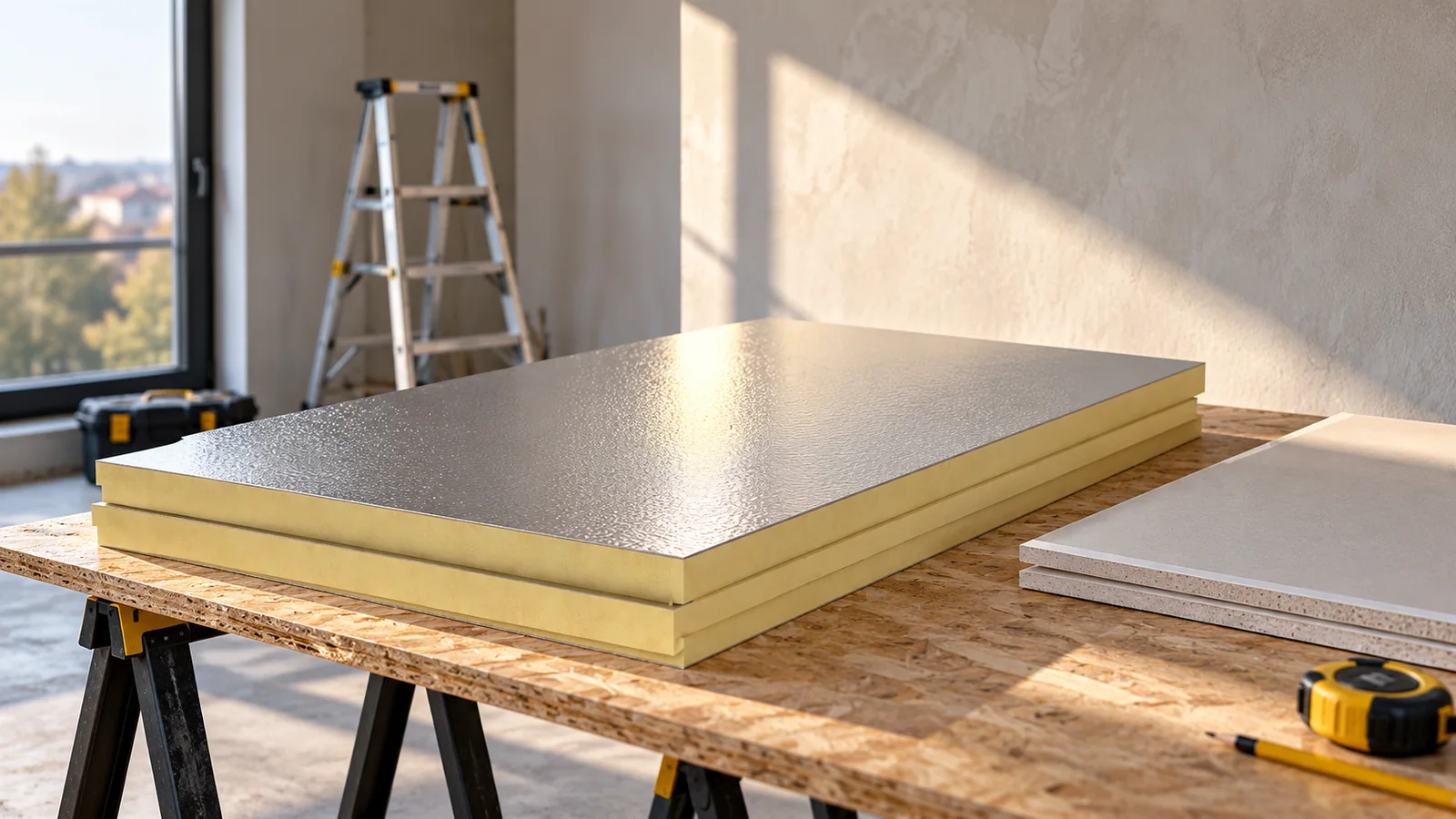
Look for a board intended for the given application. PIR products are available in thin laminates and composites with plasterboard. These are different solutions. The composite has specific rules for fixing and finishing, and its total thickness also includes the facing layer.
In one documented variant, the plasterboard layer is 12.5 mm. It should not be treated as additional millimetres of PIR. When comparing products, check the thermal resistance, the fire classification range and the substrates permitted in the instructions. The insulation thickness should result from a wall calculation, not solely from the space remaining under the window sill.
What does the aluminium facing provide?
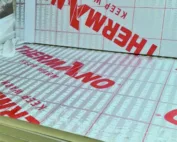
A laminate containing aluminium reduces vapour transmission through the board surface. Its significance disappears at unsealed joints. Room air can get behind the insulation through a gap, a socket or a discontinuous edge. There it will meet a cooler wall.
Continuity of the designed airtight layer is therefore needed. It covers board joints, the wall perimeter, connections to windows and service penetrations. Adhesives and sealants must match the facing. Do not attribute additional thermal resistance to a film just because it looks like a heat-reflecting surface. The effect depends on the entire system.

How to prepare the substrate and fixing?
The substrate should be load-bearing, level and cleaned of layers with poor adhesion. Loose plaster or old paint may detach together with the new insulation. Wall levelling must be planned before ordering the boards. Large unevenness should not be compensated with random dabs of adhesive.
The fixing method is specified in the instructions for the chosen system. It may involve adhesive bonding, mechanical fixing or a supporting framework. Do not transfer the principles freely between these variants. The gap left behind the board must not create a path for the free flow of moist air. Subsequent boards should be fitted so that the joints are tight and the connections are suitable for durable sealing.
Also establish the sequence of work around windows, radiators and trims. Dismantling fittings after the boards have been laid easily damages the finished seals. Before bonding the first element, it is advisable to lay out the wall layout dry. A narrow strip at a corner or above a door is often more difficult to fix. Correct cutting allows such places to be reduced and makes it possible to assess in advance how much material the offcuts will use. Large gaps must not be filled with expanding foam alone.
Where does the weak point most often occur?
Insulating a large wall area is usually easier than finishing its edges. At a window, the temperature of the reveal and the possibility of bringing the insulation up to the frame must be checked. At a ceiling, the connection to adjacent partitions is important. A corner concealed by a tall wardrobe may also be heated less by room air.
Services are best planned before installation. Any subsequent drilling can breach the seal. This applies to boxes, pipes and heavy items of equipment. The weight of cabinets is not carried by the thin insulation facing. The fixing must be taken through to a suitable substrate and the penetration point sealed at the same time.
How do you sign off finished insulation?
Before covering the layer, check the continuity of connections, corners and fixing points. There should be no open gaps or damaged film left unrepaired. The finish must correspond to the system, including its fire behaviour. PIR foam alone is not a non-combustible material.
After the work, effective ventilation is still required. Insulation does not remove the vapour produced in the home. In the first season, it is worth observing cold corners and the areas around windows. If moisture appears, its cause should be investigated rather than adding another coat of paint. A well-executed system combines thermal improvement with deliberate moisture control.
7 branches. Materials closer to your project.