How to specify swissporPIR Alu edges in the documentation
PIR insulation
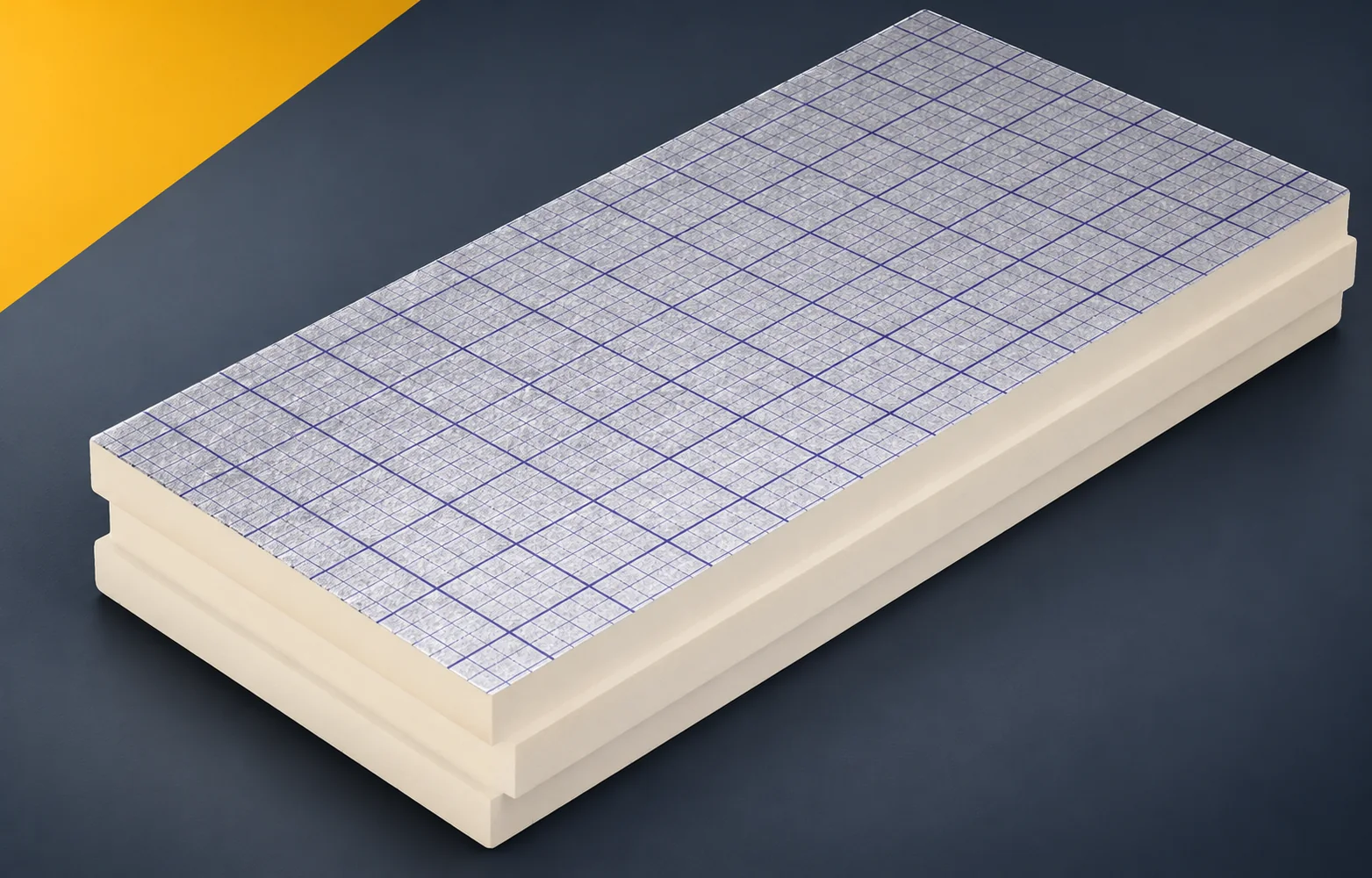
In the swissporPIR Alu documentation, the edge type is tied to the board thickness and the installation method, so not every profile is available for every variant. An unambiguous specification allows the delivery to be checked and the cut edges to be planned. The product has three edge finishes: FIT/GK is a square edge, LAP/SF is a shiplap overlap, and TAG/NuF is tongue-and-groove. The terms “polyurethane boards” and “polyurethane foam” are broader than the PIR designation, so the description of use must explicitly distinguish FIT/GK, LAP/SF and TAG/NuF and assign the correct edge shapes to each.
In this article
PIR boards with FIT, LAP or TAG edge
A short material item is not enough, because similarly named profiles do not describe the same way of fitting adjacent boards. The entry must make it possible to order a geometry that matches the laying plan and the terminations. In the documentation, give a verbal description of the edge, a drawing of its actual cross-section and the location where it is used.
Core conductivity and quality of contact
The board core has a declared lambda of 0.022 W/(m·K) regardless of the edge name; the profile primarily changes the way the joints are made. The calculation schedule should therefore state this lambda together with the function of the swissporPIR Alu edge, which is independent of it.
In the calculations, separate the thermal conductivity of the swissporPIR Alu core from the quality of execution of the joints. The edge profile does not automatically improve the lambda, nor does it remove the influence of the other thermal bridges. Verification of the solution should show the benefit of the profile as an aid in maintaining the continuity of the layer; retain the thermal properties of the board and the joint plan across the entire surface.
Polyurethane insulation after cutting the edge
The board edge must be clean, undamaged and fitted without gaps. Cutting removes the factory profile, which is why the construction design should show the cut swissporPIR Alu edge at the wall or at a projecting roof element.
The working drawing must reproduce the correct termination of swissporPIR Alu after the factory profile has been cut off. A loose tongue does not replace support for the edge section, so the geometry is chosen such that the perimeter can be fitted without open joints and unstable parts. For works inspection, specify the edge condition, the width of the cut piece and how it is supported, as well as the inspection before covering.
Relative position of the layer joints
In a two-layer system, the joints of the layers are offset relative to one another. With a single layer, the manufacturer recommends shiplap or tongue-and-groove edges on roofs. The analysis of the component’s conditions must take into account this offset of joints between the two layers of swissporPIR Alu.
The selection of seals requires planning the relative position of the joints of both layers of swissporPIR Alu. Tape on the surface does not restore the missing core nor constitute independent waterproofing, which the model and detail should reflect. The material set limits direct gaps through the thickness of the system without omitting the other layers; in the specification, describe the plan for both layers and the function of each seal, while preserving the separate roles of the protective layers.
The profile does not replace support
The tongue-and-groove profile of swissporPIR Alu joins the thermal insulation. It is not the structural interlock found in sandwich panels and does not, by itself, allow the board to span an arbitrary distance. Specify the performance requirements separately from the insulation joint.
When assessing conformity, separate the tongue-and-groove fit from the bearing capacity of the swissporPIR Alu support. The board’s interlock does not entitle you to any arbitrary spacing of supports. Check the support of whole boards as well as the structural design for transferring loads to the structure and conformity with the design.
Polyurethane insulation: the correct profile in the order
When comparing edges, establish how the usable area and the waste at the edges are calculated — the quantity ordered results from the board layout, not from the rectangular area on the plan. The purchase conditions should indicate the availability of swissporPIR Alu edge profiles from a thickness of 40 mm in accordance with the instructions.
Before ordering the thin variant, confirm the availability of the swissporPIR Alu edge in the material procedure. Do not automatically attribute the profile described for thicker elements to the 20 mm variant — one matching feature does not conclude the analysis. In the delivery agreement, state the delivery designation, the covering area and the waste from perimeter processing.
A case worth considering
In the swissporPIR Alu specification, record the edge type together with the thickness and format. The instructions specify the profiled versions from 40 mm, so do not transfer them automatically to the thinner variant. The design should take the available version into account. Also apply the requirements for the joint to cut edges so that the delivery can be assessed according to unambiguous criteria.
7 branches. Materials closer to your project.