What a SIP panel’s lambda value alone cannot tell you
SIP panels and insulation
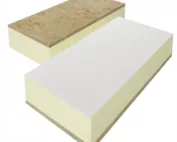
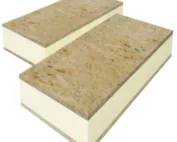
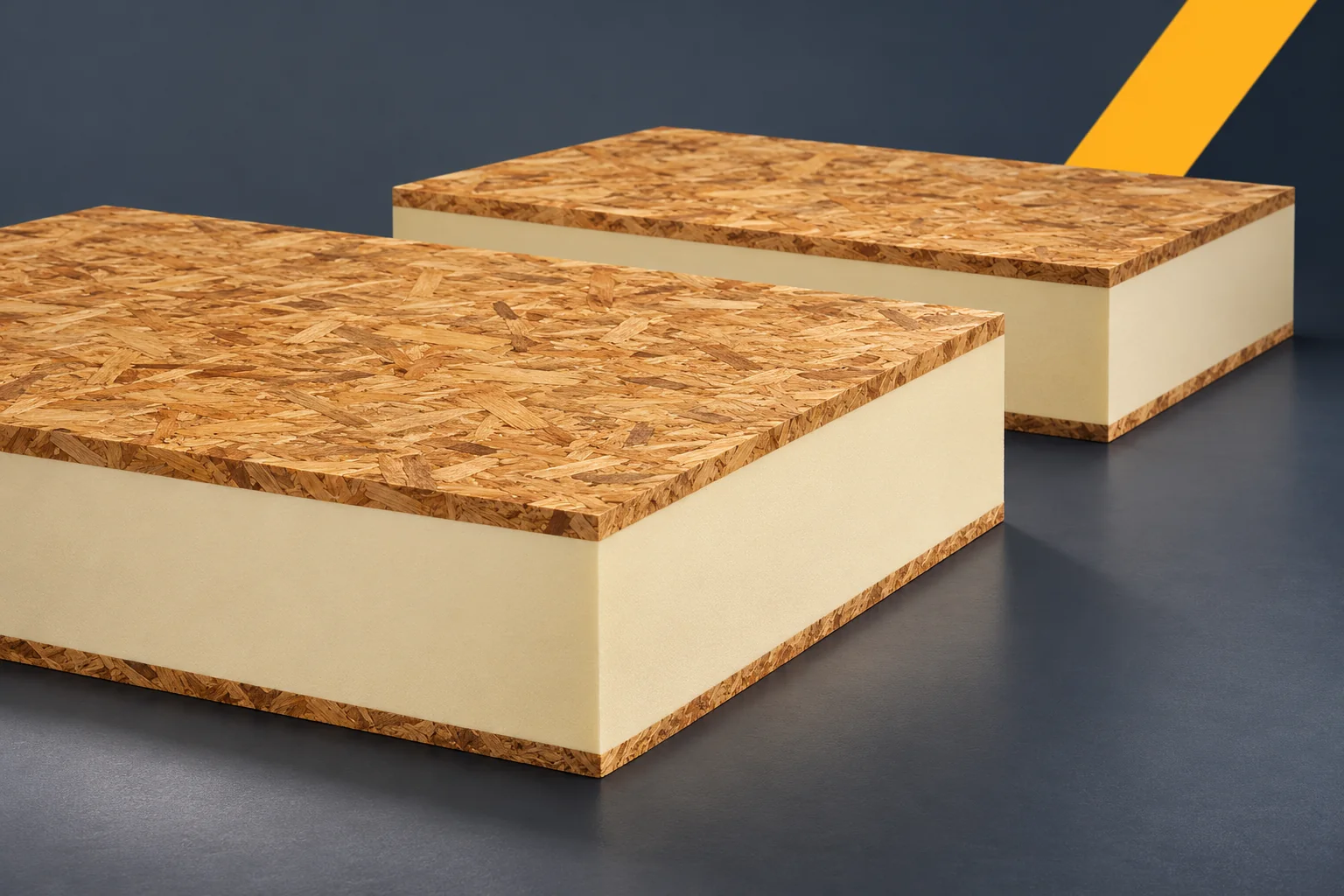
With SIP panels, the lambda value is often the first thing that comes up. It is worth knowing what it means so as not to attribute too many functions to a single number. SIP Panels, i.e. structural insulated panel, means a structural insulating panel. In solutions with a polyurethane core, a low lambda helps to limit the insulation thickness. Nevertheless, the thicknesses of the individual layers, the joints and the properties of the finished building component still have to be checked. The thermal conductivity coefficient is expressed in W/(m·K). At the same thickness, a lower value means a greater thermal resistance of a homogeneous layer. In a SIP panel, the core, the OSB and additional materials can have different lambda values. The value given for the foam does not automatically become the coefficient of the entire composite element.
In this article
Lambda refers to a specific material
You need to establish what the number on the data sheet refers to. It may be the declared value of the insulating material or a parameter used in calculations. The comparison should cover data of the same kind. The result from a fresh sample and a value that takes specific service conditions into account are not necessarily equivalent bases for choosing a board.
In the documentation it is worth looking for information on the conditions under which the properties are declared and on how material ageing is taken into account. A stable basis is needed to compare products intended for long-term use. A single attractive measurement result without a description does not provide that information. The choice of core should be based on data intended for design, not on the lowest value found.
The thickness of the core determines its resistance
The thermal resistance of a homogeneous layer can be calculated by dividing its thickness in metres by the lambda value. For 120 mm and 0.022 W/(m·K) we get approximately 5.45 m²K/W. If the panel additionally has two 12 mm OSB boards, its total thickness is 144 mm. For calculating the core alone, 120 mm is still used.
Dividing the full 144 mm by the foam lambda value would give an incorrect description of the layers. OSB requires its own data. With an example OSB lambda of 0.13 W/(m·K), both 12 mm facings together contribute approximately 0.18 m²K/W. This is a simplified summary of the material resistances, without analysis of the joints and without determining the parameters of the whole wall.
U describes the building component in the assumed configuration
The heat transfer coefficient U is given in W/(m²·K). It takes into account the relevant layers and the surface heat transfer resistances. In a real component, inhomogeneities and fasteners may also be significant. Therefore, the U-value should not be determined from the lambda value alone without knowing the cross-section and the calculation conditions.
The offer should clarify whether the stated U-value refers to the middle of the panel, the assumed wall, or another configuration. Additional cladding, a supporting substructure or the type of connection can change the result. Comparing figures from different cross-sections leads to incorrect conclusions. The clearest approach is to compare two complete solutions with the same function and requirements.
Thermal bridges and leaks act through other paths
At the panel joints there may be timber, fasteners and elements required by the structure. Their thermal effect depends on the geometry and the material. It must be taken into account when assessing the building envelope. The high resistance of the main panel field does not remove the need to detail the corners, the base and the window perimeter.
Air leakage is yet another phenomenon. Heat can be lost together with air flowing through an imprecisely executed joint. The lambda value does not describe this flow. Tight joints and their inspection help to make use of the insulation properties. The performance of the building therefore depends both on the material and on the way it is joined.
Compare PUR, PIR and EPS on a common basis
For cores with lambda values of 0.022 and 0.038 W/(m·K), achieving a thermal resistance of 5.00 m²K/W requires 110 mm and 190 mm of insulation respectively. This is a pure comparison of homogeneous layers. It shows why the more favourable lambda value of a polyurethane core can help to reduce thickness. It does not constitute a ready specification for two interchangeable panels.
EPS comes in various grades, and PUR and PIR also do not share a single common lambda. The value must be attributed to a specific material. When you compare ready-made SIP panels, also check the facings, the load-bearing capacity and the required finish. An advantage in one parameter does not determine all the characteristics of the product or the cost of the entire solution.
The room temperature requires a balance
The promised indoor temperature cannot be calculated from lambda alone without additional data. What is needed includes the external conditions, the areas of the building envelope, the windows, the ventilation and the heat sources. In summer, variable solar gains and cooling capacity are added. The same board can perform in buildings with very different levels of comfort.
Similarly, the heating time depends on the heat capacity of the interior and the output of the appliances. A heavy floor stores energy differently from lightweight construction. A low lambda of the core limits conduction through its layer, but does not describe heat storage in the whole house. It is worth keeping this distinction in mind when discussing seasonal use.
A short data sheet should lead to the full description
A reliable assessment requires the core thickness, its declared lambda and a description of the facings. Drawings of the connections and a cross-section of the finished wall are also needed. If a U-value is given, you should ask for the calculation assumptions. Then the figures become comparable and you can check where the benefit actually arises.
SIP panels with polyurethane are interesting precisely because they combine effective insulation with a prefabricated element. The right selection consists in making use of the low lambda without attributing to it promises regarding fire, acoustics or load-bearing capacity. Each of these properties has its own documentation. Together they form a picture of the product that a single number alone cannot replace.
7 branches. Materials closer to your project.