Specifying Kingspan PIR: defining an equivalent alternative clearly
PIR insulation
Kingspan boards must be described in the specification by the full product designation, because the brand alone does not indicate the type of core. Therma TR26 and Therma TR27 have a PIR core, whereas the Kooltherm family is based on phenolic foam. The specification should therefore state the correct material, the facing and the intended place of application, and clearly identify the adopted variant in the documentation. In a project description that states only the Kingspan brand without a specific family and variant, these data must be completed so that the criteria for assessing equivalence refer to the correct product.
In this article
Unambiguous specification of the product
Recording only the name itself is not sufficient, because the manufacturer’s name covers various materials, including PIR Therma and phenolic Kooltherm. The functional assumptions are intended to allow the material suitable for the designed function and method of execution to be identified unambiguously. In the design documentation, state the full product name, the core type, the declaration of properties and the place of application in the building, together with a reference to the relevant section.
Assumptions for the calculations
The thermal equivalence of TR26 and TR27 is established for specific variants, even if both have the same thickness. For TR26, the reference point is a lambda of 0.022 W/(m·K), whereas for TR27 the value depends on the selected thickness. The calculation must take this difference into account; a shared brand is not a basis for assigning a single parameter to both boards.
The Kingspan variants being compared are set against the same required thermal resistance. Lambda must remain assigned to the declared range, because extending a lower value across the whole brand distorts the parameters of the other product families. Project verification should make it possible to check thermal equivalence at the level of precisely designated offer variants. In the calculations, retain the lambda for the selected thickness, the correct RD and the consequences of changing the height of the assembly.
Material requirements and inspection of execution
The reaction to fire of the material and the fire resistance of the building element describe different properties. The compression result at 10% deformation is also not a ready-made design load value. In the table of mechanical and fire requirements, distinguish between data on the material’s reaction to fire, compression and the fire resistance of the entire building element.
Assign each Kingspan parameter to the correct test and scope of application, so that the product document does not replace the required assessment of use. Evidence for one case cannot be extended arbitrarily, because one favourable property of a board is not proof that every requirement for the building is met. The product and application documents must make it possible to assign each parameter to the correct test and to the actual function of the product under consideration. When approving a material, provide the full declaration of the variant and the documentation of the assembly in terms of load-bearing capacity and fire requirements with the actual configuration of the building element.
The conditions for accepting a Kingspan substitute should list the characteristics to be compared: core, facing, thermal resistance, geometry and scope of application. Brand conformity alone is not a technical criterion, and one fire class does not replace all the required assessments of the system. It is worth recording the material decision together with its consequences for the joints and other elements of the building envelope.
Separate technical requirements
The Therma insulation board is not the same product as a complete sandwich panel with structural facings — assign the load-bearing function, the fixing and the method of forming the sealing layers to the actual solution. The analysis of the moisture conditions should cover the change of insulation product in a cross-section that has separate vapour control and water protection layers.
The material change must preserve the continuity of the designed protection against water and vapour flow in accordance with the thermal and moisture conditions adopted for the building envelope. The description “polyurethane foam” does not close the analysis, because a similar board colour does not confirm the same conditions of connection with the membrane or flashing. The adopted layers and their joints must allow the correct protective system to be maintained regardless of the chosen rigid insulation family. In the specification, explain the description of all layers, the perimeter details, the scope of documentation for the proposed substitute and the limits of responsibility of the individual layers.
Description of connections in the design
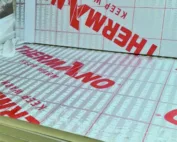
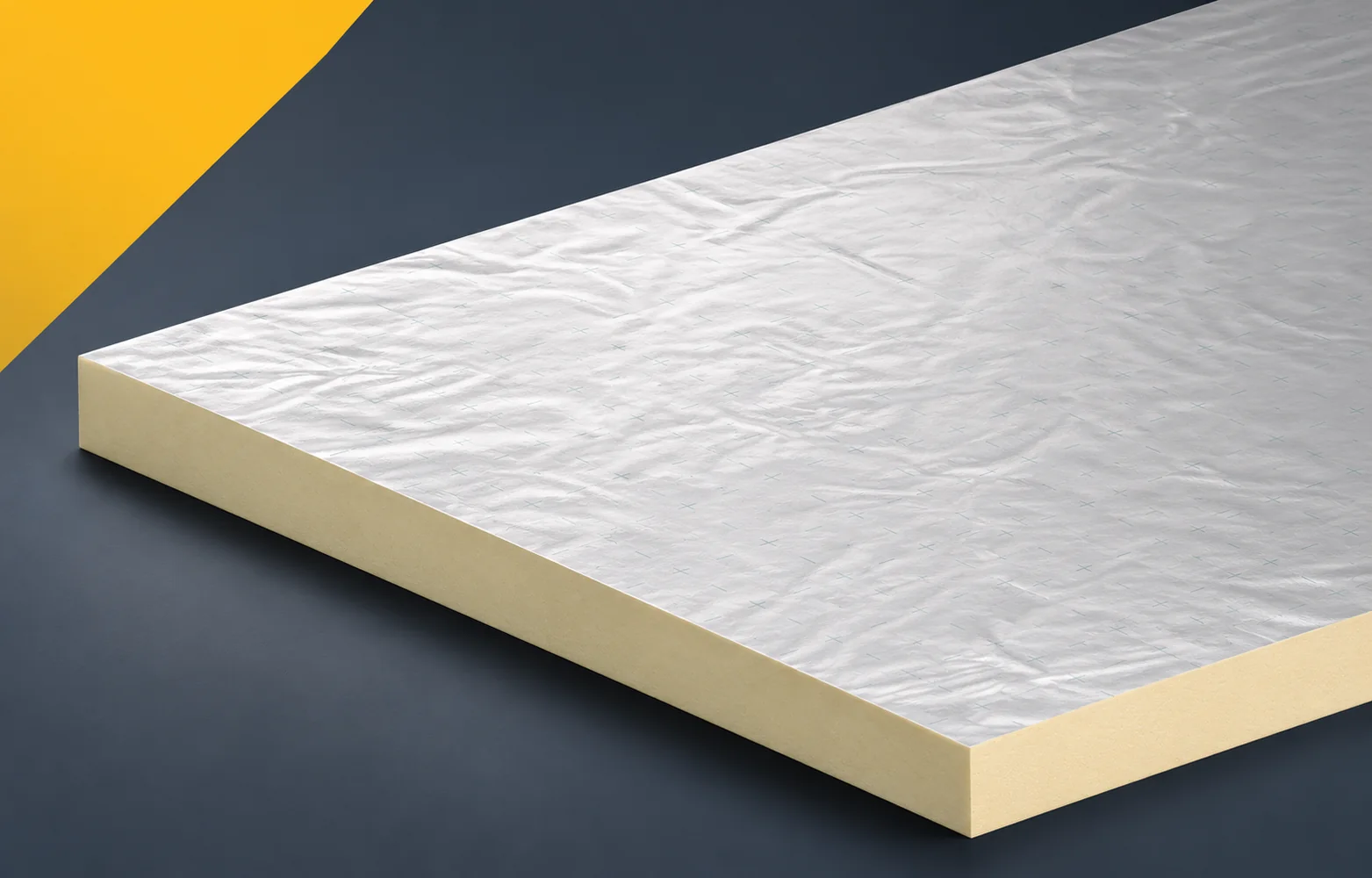
TR26 has a facing containing aluminium, and TR27 has a glass fibre facing. The construction of these surfaces determines how the layers of the designed roof are joined, so on the construction drawing describe the replacement of the TR26 aluminium facing with TR27 glass fibre in the roof description.
The new facing must match the fixing and the covering, and show how this is checked on a construction drawing. A common PIR core is not enough to substitute a product without assessing the joints between the layers, so do not leave this to a decision made on site. The geometry should preserve the function of every joint after a material change during construction. For polyurethane insulation, state how, at acceptance, the type of surface, the permitted method of jointing and the side geometry of both compared boards are to be checked.
Principles for assessing equivalence
The offer for Kingspan insulation should contain the full product designation and thickness. Assess a proposed substitution by its effects on the entire system, not by the shared PIR designation. In the bill-of-quantities item ‘insulation with polyurethane’, analyse the proposal to replace one Kingspan board with another of a similar name or the same surface colour.
Compare Kingspan boards together with the changes needed in the other layers, and keep the agreed criteria legible when assessing the substitute. Compliance with a single property is not enough, because a price difference may result from a different application rather than from a saving with an identical effect. Agree the equivalence criteria before approving the purchase and changing the construction documentation. Enter in the compliance record the required thermal resistance, the geometry, the method of fixing and the cost of adapting the adjacent layers.
7 branches. Materials closer to your project.