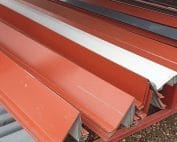
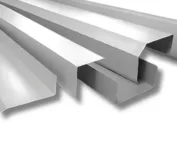
Bending prepainted sheet without spoiling the shape or finish of the flashing
Sheet metal flashings
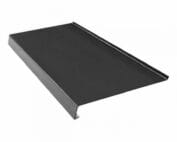
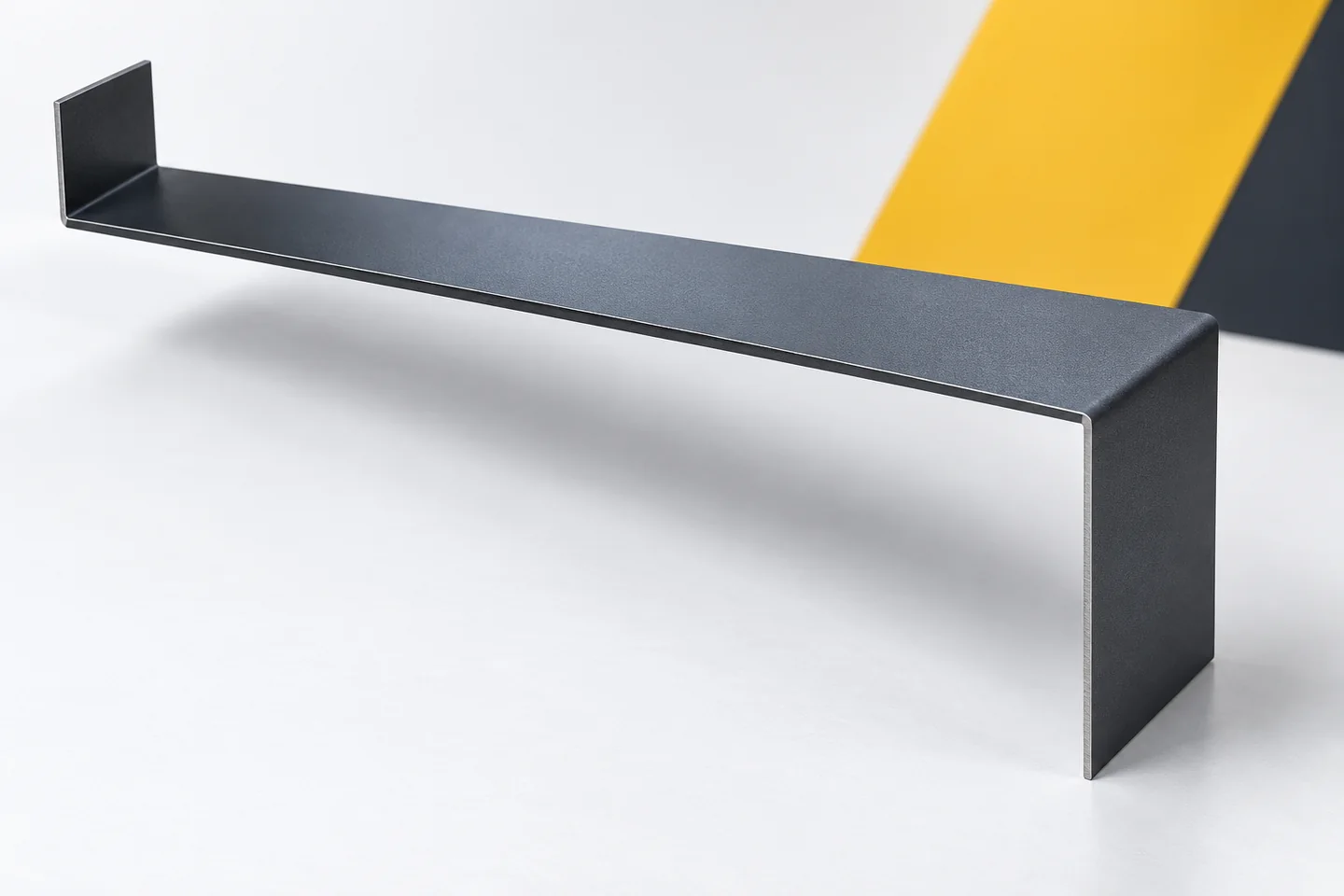
Non-standard flashings are made from flat sheet, but once bent they must satisfy several requirements at the same time. They must fit the building, keep the correct surface, and be installable. Matching leg lengths alone is not enough. The material, the actual shape of the corners and the bending sequence all matter. It is worth agreeing these points before production, especially when the flashing will be visible along a long stretch of façade. Coated sheets are not a single variant with identical forming capabilities. The type of substrate, the thickness and the arrangement of the protective layers all matter. The shape should match the properties of the specific sheet. The material should not be changed arbitrarily once a demanding cross-section has been approved.
In this article
Choose the material before specifying tight bends
Galvanised and aluzinc sheets require a similar assessment. A metallic surface does not mean it can be bent and straightened without limits. The contractor should confirm that the profile can be produced. This avoids a situation where a correct geometric drawing turns out to be incompatible with the technology.
Corners have a real radius
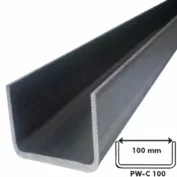
On a simple sketch, a bend often looks like a sharp point. The finished sheet, however, has a radius determined by the material and the tool. This can affect the space inside the profile. It matters for flashings that wrap around a panel edge or slide into a prepared gap.
Dimensions must therefore be read in an agreed way. Internal clear width and external dimension are not the same. Not all data should be rounded without assessing the fit. If necessary, a test piece should be checked before a larger number of pieces is produced.
The colour side should be unambiguous
The visible surface must be marked on the cross-section. With asymmetric flashings, an incorrect orientation cannot always be corrected by turning the element over. Barge flashings and chimney flashings require particular attention when they have different legs. A colour code alone, without indicating the side, is an incomplete description.
The expected surface character must also be specified. Matt and glossy sheet can look different despite a similar colour. At the bend, light reflects at different angles, which further highlights the differences. The material sample should correspond to the coating actually ordered.
The forming sequence affects feasibility
A cross-section with multiple bends must be formable with the available tools. Adjacent legs can restrict access during the next operation. That is why non-standard flashings require technological confirmation. A more elaborate sketch is not in itself an advantage of the product.
Sometimes a solution made of several cooperating components will be appropriate. This does not mean randomly cutting a finished flashing on site. The division must be planned together with the joint and the water path. The function of the detail must be preserved regardless of the number of parts.

Limit on-site adjustments
The component should arrive with a cross-section matched to the agreed location. Strong bending and repeated straightening of the same edge can worsen the condition of the coating. If the flashing does not fit, the measurements must first be compared with the drawing. It is worth establishing whether the substrate or the product itself has changed.
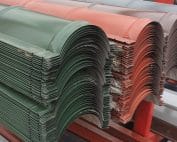
Ridge caps and gutter aprons should also not be treated as arbitrarily pliable strips. Their bends have a specific function. Starter profiles, in turn, must correspond to the layout of the cladding. A change in shape must not accidentally change the way it is supported, connected or drained.
Transport is part of preserving quality
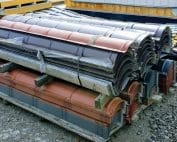
A well-made profile can be damaged after leaving the workshop. Long legs require proper support, and surfaces require protection against friction. Packs should not be moved in a way that causes sharp edges to slide over the coating. A clean place for setting them down must also be prepared.
After unpacking, it is worth inspecting the edges and bend lines. A local crease can hinder later installation. A deformed component should not automatically be pressed down with additional screws. First, it must be assessed whether the shape can be restored without damaging the material or changing the detail.
Assess appearance together with function
The assessment of a finished flashing includes dimensions, the colour side and the condition of the surface. Equally important is whether the part can be properly fitted and connected. A nice-looking profile with the wrong clearance will not fulfil its task. Conversely, a fitting component with a damaged coating may require repair or replacement.
It is worth keeping the final drawing and the material markings from the delivery. They will help with future orders and during maintenance. Non-standard flashings provide the greatest benefit when they solve a real problem of the building. Well-agreed bending combines dimensional accuracy with surface protection and efficient installation.
Questions and answers
Can every drawn cross-section be bent from any sheet metal?
No. The limitations arise from the material, thickness, tooling and access to subsequent bends. Feasibility must be confirmed before ordering.
Can a finished flashing be straightened and re-bent repeatedly?
Such corrections should not be treated as neutral. They can change the geometry and damage the coating. In the event of a mismatch, the cause must first be established.
7 branches. Materials closer to your project.