Choosing roofing membranes for each layer in the roof
Construction and installation
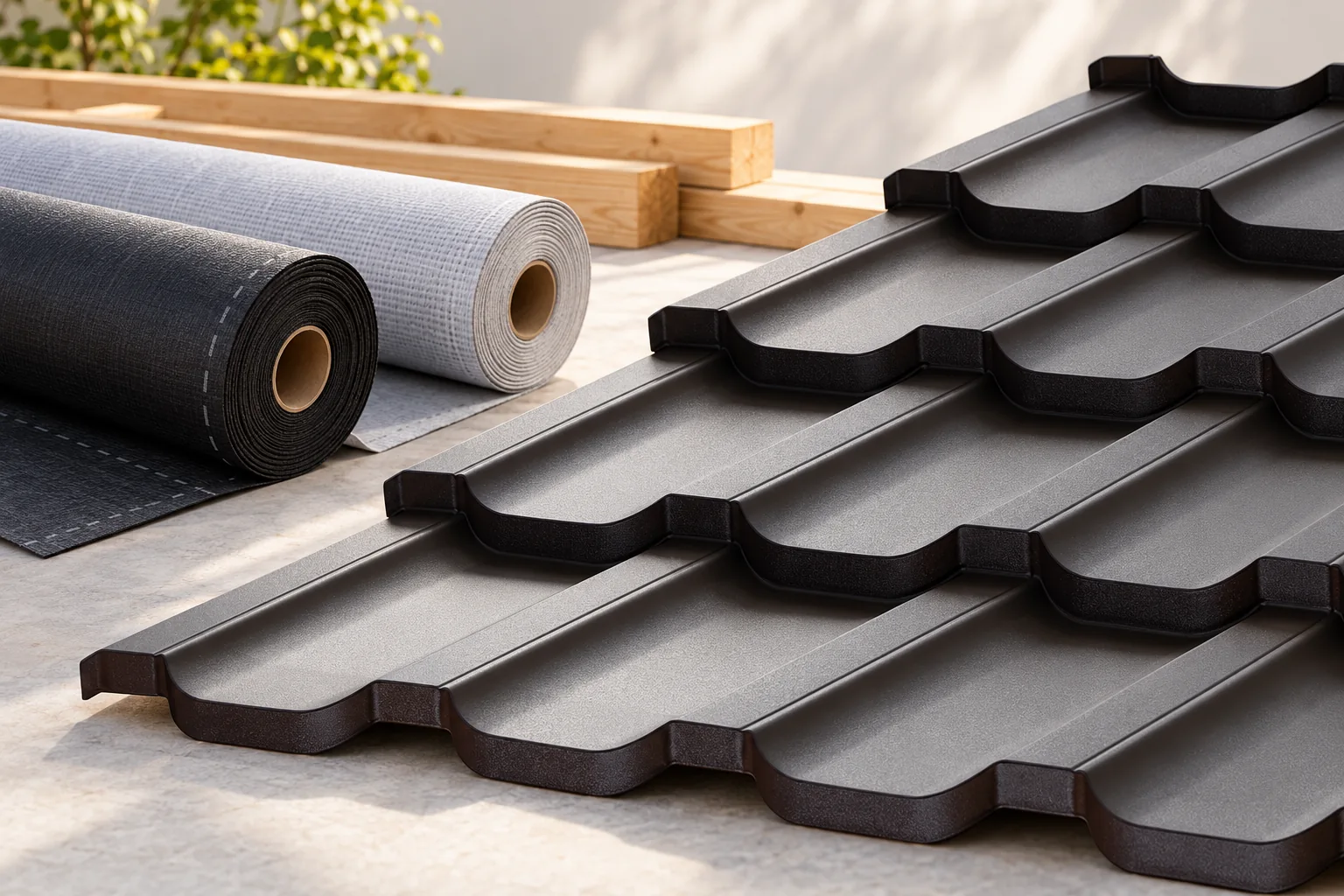
The choice of roofing membrane is determined above all by its position and role within the layer build-up, not by the weight of the roll alone. First establish whether you need an underlay membrane, a vapour barrier or both, then check how they fit the roof design. Take into account the substrate, permitted contact with thermal insulation, exposure time and how laps and junctions at walls, chimneys and services are sealed. Compare the declared properties and intended use of the product, since the term roofing membrane covers materials with different functions.
Which layer do you actually need?
The term roofing membrane covers materials with different properties. An underlay membrane helps drain water that gets beneath the covering. A vapour control layer restricts the passage of water vapour from the inside. These terms should not be used interchangeably.
The roof design should specify the sequence of layers and their functions. A heated attic is handled differently from an uninsulated carport. Buying a single universal membrane for both sides of the insulation can create an assembly that hinders the drying out of the building component.
What does the Sd value mean?
Sd describes the diffusion resistance of a material as the equivalent air layer thickness. A lower value means easier transmission of water vapour, a higher value greater resistance. The parameter helps determine the position of the membrane in the roof. It is not, however, a standalone assessment of product quality.
A low Sd value is often desirable in an external membrane, but it does not mean that the membrane is suitable as a vapour control layer. On the inside, the requirements follow from the thermal and moisture design. The type of insulation, coverings and external layers must be considered together.
Can the membrane touch the insulation?
Not every membrane permits direct contact with thermal insulation. Some solutions require an additional ventilation gap. The answer should follow from the instructions for the specific product and the designed build-up. The term “roofing membrane” alone is too general.
Compatibility with full boarding or another substrate must be checked separately. A product laid on continuous support may have different requirements from a membrane stretched between rafters. During renovation, the old layers that remain in the assembly are also important.
Weight does not replace technical parameters
Grammage indicates the mass of the material per unit area. It does not directly determine its watertightness, durability or tear resistance. Two membranes of similar weight may have a different construction. Their declared properties and approved applications must be compared.
In the data sheet, it is worth checking watertightness, tensile strength and tear resistance in both directions. Resistance to damage around fasteners also matters during installation. The selection should match the operating conditions, not solely the principle that “heavier is better”.

How long can the membrane remain exposed?
The permissible UV exposure time depends on the product and the conditions stated in the instructions. A declaration of several months for one material does not apply to the entire category. The schedule must allow for the membrane to be covered with the appropriate covering.
Light entering from the attic side may also be relevant. It is therefore worth checking the requirements for closing the roof from the inside. An underlay membrane does not become a permanent covering merely because no leak is visible during the first rain.
The joints form a functioning layer
Laps, tapes and seals are selected to suit the membrane and the substrate. The tape must have the required adhesion and intended use. Bonding on a wet, dusty or frozen surface may not provide a durable joint. The application conditions specified by the supplier apply.
Walls, chimneys, windows and ducts require particular attention. The continuity of the vapour control layer is also important for airtightness. A small unsealed opening can allow moist air to flow through. A high Sd value of the membrane alone does not close such a leak.
Ventilation and drainage must remain unobstructed
The membrane must be integrated into the designed arrangement of the eaves, ridge and ventilation. Water should reach the intended drainage point, not the insulation or the wall. At windows and other obstructions, separate water drainage above the opening may be required.
The space beneath the metal sheet functions according to the adopted arrangement of counter-battens and battens. It must not be accidentally blocked with insulation or foam. A vapour-permeable membrane does not replace the air exchange required in the cavity beneath the covering.
What should the order include?
Besides rolls, you also need to allow for tapes, adhesives and components for sealing penetrations. The quantity of material follows from the surface area as well as laps, offcuts and details. The price of the roll alone does not show the cost of the finished layer. It is worth comparing complete sets for the same roof.
The documentation should specify the exact product, the method of laying and the permissible installation conditions. Before covering, it is worth taking photos of the joints. They make it easier to assess later moisture problems and allow you to check places that are difficult to reach once the loft is finished.
7 branches. Materials closer to your project.