PIR roof panel or EPS-core panel? How to compare the options
Sandwich panels
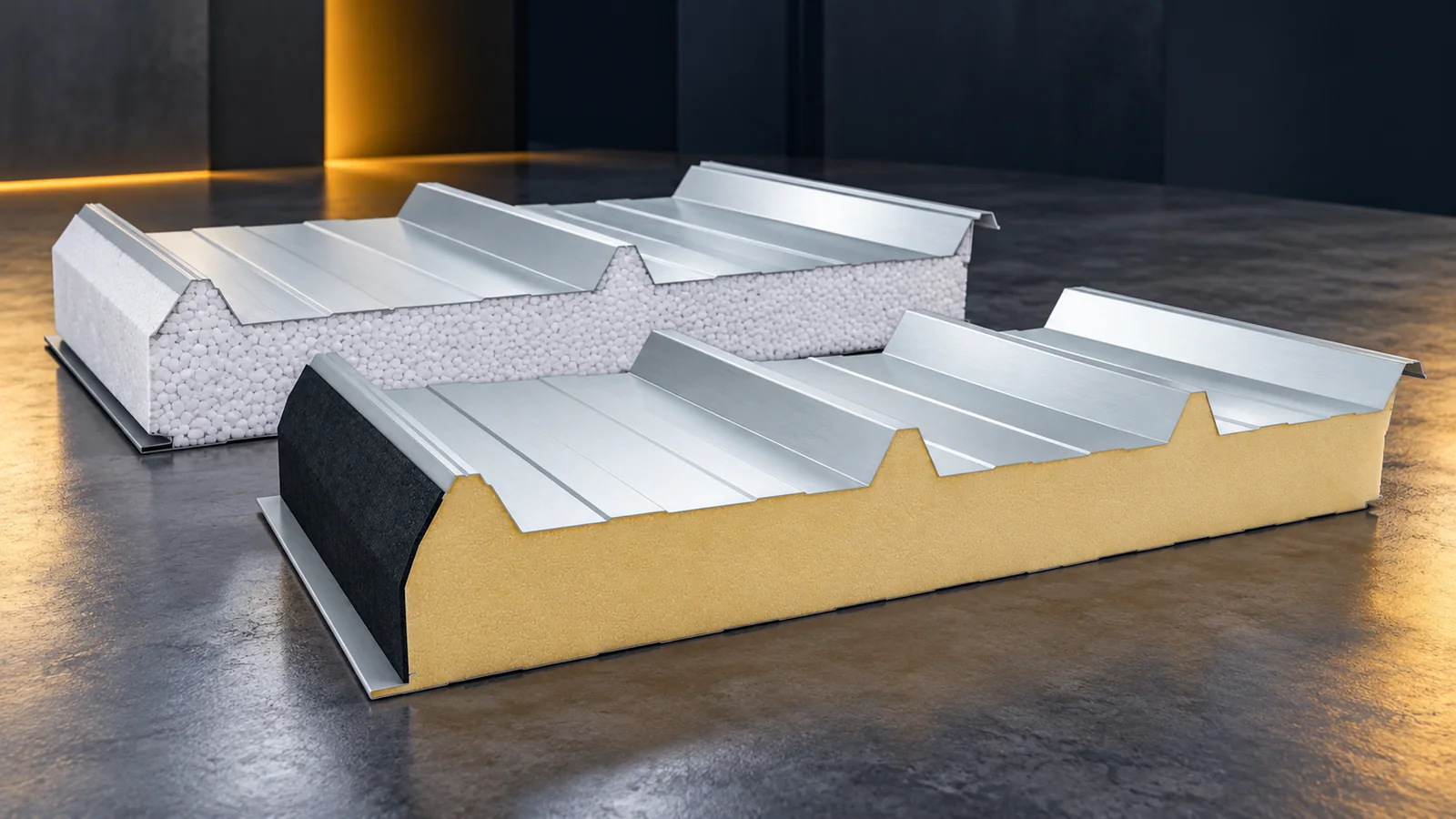
A PIR roof panel usually achieves better thermal insulation at a smaller thickness than a comparable EPS-core panel. The polystyrene variant can be cost-effective and lightweight. However, the choice should be governed by the requirements of the entire roof. U-value, loads, the range of fire classifications, coatings and installation cost must be compared. The same thickness does not mean the same thermal function. An insulated roof panel has metal facings and a bonded core. Its price should not be compared directly with a PIR insulation board alone or a pack of EPS. These materials require other layers to form a roof. In both panel variants, the outer profile and the joints are part of the roofing system.
Are we comparing the same products?
An insulated roof panel has metal facings and a bonded core. Its price should not be compared directly with a PIR insulation board alone or a pack of EPS. These materials require other layers to form a roof. In both insulated panel variants, the outer profile and the locks are part of the roofing system.
Also check the sheet thickness. A cheaper offer may involve different facings, coating or length. The note “100 mm panel” alone leaves too many unknowns. A comparison requires the intended use, geometry, core and performance requirements. Only then can you assess whether the price difference relates to a comparable scope.
How large can the difference in insulation be?
In the sample datasheets, a 100 mm PIR roof panel has Uc = 0.21 W/(m²·K), while a 100 mm EPS panel has Uc = 0.37. In the latter family, the 200 mm variant achieves Uc = 0.19. These are data for specific products. They show, however, why thickness alone is not a good comparison criterion.
For a heated building, first select panels that meet the required thermal parameter. Then compare cost, weight and installation conditions. Do not divide the total trapezoidal height by the core lambda and treat the result as the U-value of the finished panel. The profile, joints and declaration method matter. Use the appropriate product tables.
Also determine whether the comparison concerns a new roof or a re-covering on existing supports. For a new building, various support spacings can be considered. In a renovation, this spacing may already be fixed. A variant with an attractive price and good U-value will be ruled out if its scope of application does not match the supports. Ask for separate confirmation of the thermal result and the structural design. Thicker EPS may approach the U-value of thinner PIR, but the available length, flashings and lifting method must be checked. Thermal equivalence is only one of the selection conditions.
Will PIR always be lighter?
No. Compared with a mineral wool core, PIR often offers lower weight, but EPS can be lighter than PIR. For the specified 100 mm roof panels with 0.5/0.5 mm facings, the weight of a sample PIR variant is 12.6 kg/m², and EPS is 9.9 kg/m². This is important so as not to transfer an advantage from one comparison to another.
However, weight does not determine the permissible support spacing. The panel must meet the load-bearing and deflection requirements. Tables are needed for its facings, thickness and scheme. Do not assume that a light core means a weak panel or that a thicker product will carry every load. The data must correspond to the actual structure.

How to compare fire behaviour?
A distinction must be drawn between reaction to fire, fire resistance and exposure to external fire. The BROOF(t1) classification does not mean that the core is non-combustible, nor that the roof will achieve any given REI class. Each of these pieces of information has a different scope. The absence of a declared parameter does not provide grounds for adopting it independently.
Check the documentation for the specific assembly. Conditions may apply to span, fixing and sealing. PIR should also not be described as non-combustible. If the building has requirements that a given variant does not meet, a low price will not solve the problem. The solution must be changed in accordance with the design.
What matters for airtightness and durability?
In both variants, correct slope, joints, fasteners and flashings matter. A thicker core will not fix a mistake at the chimney or a badly made overlap. The panels must be installed according to the instructions for the relevant product. Conditions for continuous elements may differ from a layout joined along the length.
Match the coating to the surroundings and the interior. An agricultural environment, a wet process or aggressive chemicals require a different approach than a dry warehouse. Neither an EPS nor a PIR core provides resistance of the coating to every cleaning agent. After installation, the roof must be inspected, dirt removed and damage repaired in accordance with the maintenance rules.
When should you choose which variant?
PIR is a strong candidate where good thermal insulation and limited thickness are required. EPS may be a reasonable choice where it meets the design and offers a favourable whole-roof cost. However, it should not be assumed in advance to have a single price or availability date. A quote for the specific scope is needed.
Take into account the structure, flashings, installation and transport. Check production lengths and the effect of colour on the permissible layout. Where both variants meet the requirements, comparing the full cost will be fair. Where only one meets them, the price per metre of the other is no longer a comparison of equivalent solutions.
7 branches. Materials closer to your project.