What determines the price per square metre of trapezoidal steel sheet?
Sheets and roofs
The price per square metre of trapezoidal steel sheet depends on the profile, thickness, coating and unit of billing. The price list may show total m², covering m² and linear metres of sheet. The amounts must be standardised before comparison. Below we show a dated example of T18 and T35 prices and how to assess surcharges. This allows the price of the sheet itself to be separated from the cost of covering a specific roof or façade. Total square metre describes the area of the sheet in the adopted billing unit. Covering square metre takes into account the standard side lap. Linear metre, in turn, means a section of sheet one metre long and the width of the given profile. These units are not interchangeable without conversion.
Total, covering or linear metre?
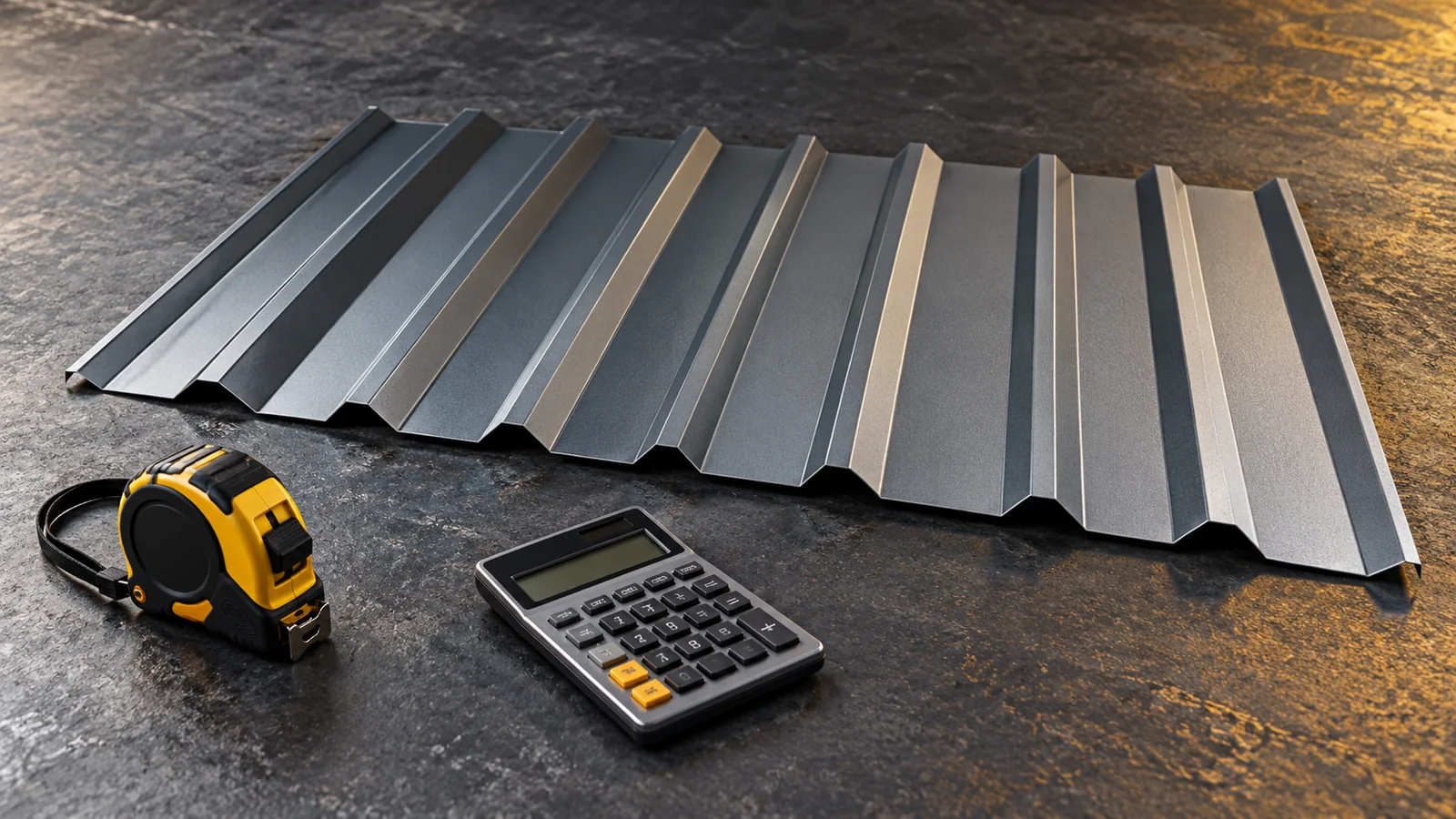
A total square metre describes the sheet area in the adopted billing unit. A covered square metre accounts for the standard side lap. A linear metre, in turn, means a one-metre length of sheet at the width of the given profile. These units are not interchangeable without conversion.
If an offer gives a price per linear metre, divide it by the coverage width expressed in metres. You will get the price per nominal covered m². For a total-width price, the ratio of total width to effective width is needed. Do not then add the same lap again. Angled cuts and longitudinal joints remain a separate part of the cutting plan.
The example concerns T35 with a total width of 1.082 m and a coverage of 1.035 m. The quotient of these values is approximately 1.045. A price per total metre therefore requires conversion to compare it with a price per covered metre. Minor differences due to rounding may occur in the price list. It is best to use the column given in it for the correct unit. A lower value from another column should not be regarded as a cheaper offer for the same coverage range.
How does the profile change the price?
The sheet is formed from a strip of material. A higher or differently shaped profile may yield a different usable width from a comparable input. The thickness and grade of steel also matter. You should therefore not expect an identical price per covered metre for different sections simply because they have the same colour.
The symbol T18 or T35 does not specify one width among all suppliers. The specific drawing must be checked in the offer. Otherwise it is easy to compare prices for material whose quantity needed for the roof will differ. When buying missing sheets, conformity of the profile becomes more important than the rate itself. A similar height does not guarantee that a correct lap can be made.
What do sample list prices look like?
The following gross prices refer to the covered m² of two specific models. They come from the price list of 28 October 2026 and do not constitute a shop offer.
| Material | T18 | T35 |
|---|---|---|
| 0.50 mm, polyester 25 µm | €10.34 | €11.31 |
| 0.60 mm, polyester 25 µm | €13.30 | €14.29 |
| 0.70 mm, polyester 25 µm | €16.25 | €17.26 |
| 0.50 mm, matt polyester 35 µm | €11.82 | €12.80 |
The comparison shows the impact of the specification. It does not determine which thickness should be purchased. The selection must match the loads and supports, and the final quote may include discounts and availability.

What are you paying for with a better coating?
The coating affects corrosion protection, appearance retention and warranty conditions. The choice should take into account the external environment and conditions on the underside of the sheet. A roof in a typical environment and a building envelope with an aggressive internal atmosphere do not necessarily need the same specification.
Do not compare only the paint thickness. Its type and confirmed properties are important. Colour and texture are separate criteria. A matt surface does not automatically mean the highest resistance. If the price includes an extended warranty, read the terms. They may require specific installation, maintenance and formalities. The surcharge should correspond to actual needs, not just the name of the variant.
What surcharges should you check in the order?
The quote may include surcharges for anti-condensation fleece, a non-standard colour or a specific length range. It must be established in which unit they are calculated. A surcharge per total metre is not identical to a surcharge per covering metre. For fleece, it is also worth confirming how the eave and overlap zones are prepared.
Check transport, unloading and the minimum conditions for delivery separately. A small order may have a different cost structure than a full truckload. Do not treat the unit price from a large project as a guaranteed price for a few sheets. The comparison should include the same quantities, lengths and delivery location. Only then can you see the actual difference between offers.
How do you choose a favourable offer?
Ask for a clear material specification and a quantity schedule after cutting. Check whether the price is net or gross and when it expires. Compare parameters and the full purchase cost, not just the largest discount figure. An offer with a low base price may have higher surcharges or not include the required accessories.
If the material is discounted because it is second grade, a description of the specific defect and batch documents are needed. Missing data on thickness or application is not a commercial detail. It may make it impossible to assess suitability for the roof. A favourable purchase is material that meets the requirements, calculated in the correct units and delivered under the agreed conditions. The price of a single square metre describes only part of that decision.
7 branches. Materials closer to your project.