PIR, EPS, XPS or mineral wool? When thin insulation delivers the greatest benefit
PIR insulation
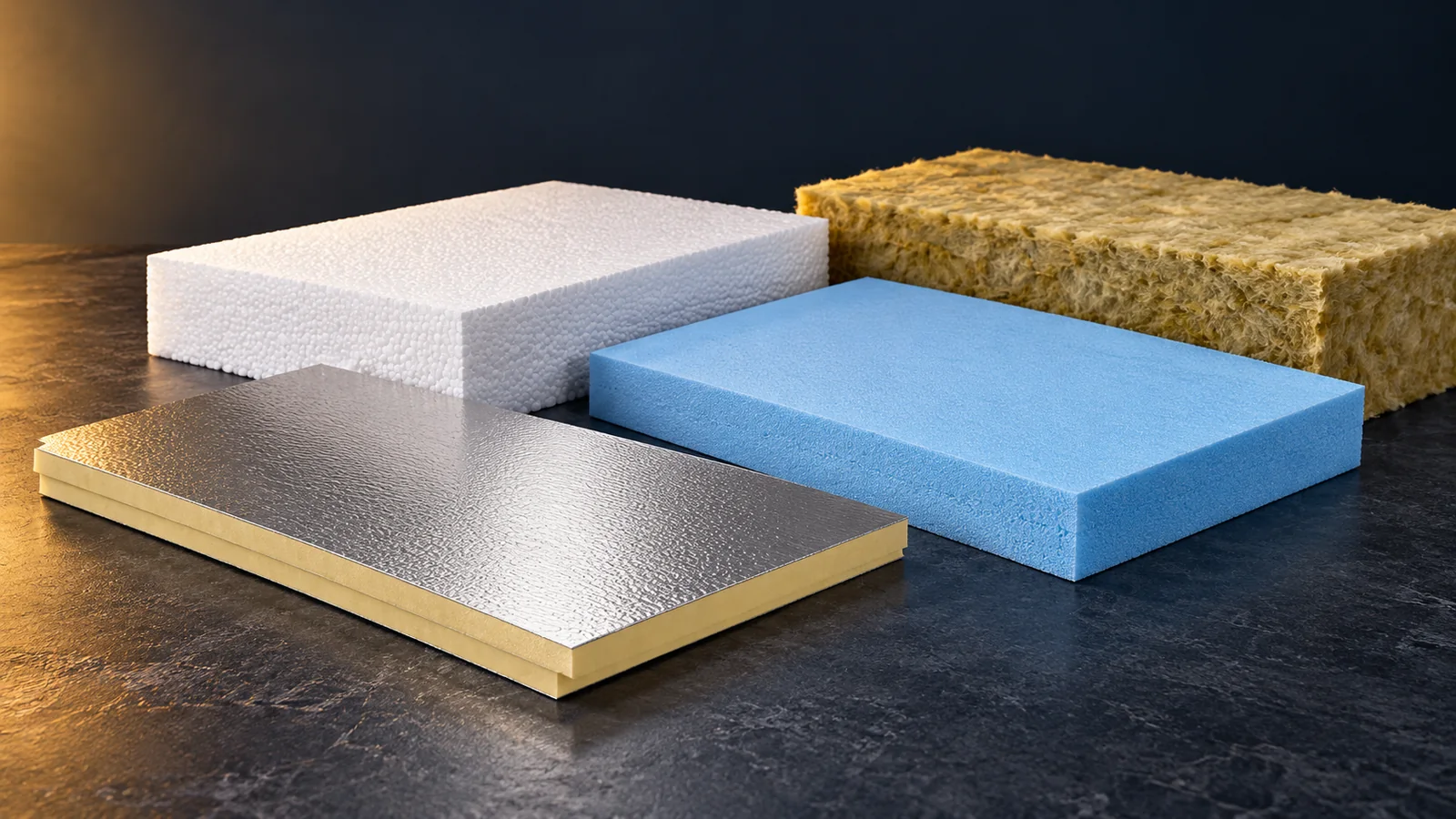
PIR has a clear advantage where high thermal resistance is needed at low thickness. This does not mean it is superior in every application. EPS can be cost-effective, XPS under specific moisture and pressure conditions, and mineral wool where fire or acoustic requirements apply. A good choice follows from the installation location and the properties of the specific product. Lambda alone does not describe the whole insulation. A low terrace threshold, a short eaves overhang or a small room can limit insulation thickness. In such places PIR achieves greater resistance than many materials of the same thickness. For example, a 100 mm layer at a lambda of 0.022 W/(m·K) has a resistance of approximately 4.55 m²K/W.
When does lack of space favour PIR?
A low terrace threshold, a short eaves overhang or a small room can limit the insulation thickness. In such places PIR can achieve a higher resistance than many materials of the same thickness. For example, a 100 mm layer at a lambda of 0.022 W/(m·K) has a resistance of about 4.55 m²K/W. At a lambda of 0.036, a similar result requires about 164 mm.
This is a strong argument in renovations. However, the difference in thickness should not be converted into the same percentage of energy savings. If the final U-value of both solutions is similar, the benefit relates primarily to space. The PIR must also be selected for the given assembly. A roof board in foil is not automatically a ready substrate for façade render.
When does EPS remain a sensible solution?
Where there is enough space and budget matters, EPS can be a good choice in a suitable system. There are various façade, floor and foundation grades. They differ in lambda, strength and behaviour with water. PIR should not be compared solely with one generic “polystyrene”.
For an example graphite EPS with a lambda of 0.031, the difference in required thickness compared with PIR 0.022 is smaller than with EPS 0.036. In a façade design, the adhesive, fasteners and finish also matter. If a thicker layer does not complicate the details, the cost of the complete system may favour EPS. The decision should take account of the expected effect, not just a fashionable material label.
Where can XPS have an advantage?
XPS is used in solutions where water conditions and mechanical parameters matter. Selected boards have a compressive stress at 10% deformation of 300 kPa or more. This does not mean that any XPS board can replace another insulation without checking. Here too, the correct variant and documentation are needed.
For foundations, inverted roofs or high loads, the low lambda of PIR may not be the most important criterion. Water absorption, creep, frost penetration and the entire layer assembly must be taken into account. The CS parameter must not be treated as a permissible permanent load on the floor. Water and pressure are separate issues that board thickness does not resolve.

What speaks in favour of mineral wool?
Mineral wool is worth considering in assemblies with specific fire and acoustic requirements. There are soft products for filling spaces and rigid boards with different properties. They do not have identical density or mechanical parameters. The selection depends on the structure and the way the insulation works.
PIR will not automatically replace a material required in a non-combustible system. Nor can it be assumed that good insulation will deliver the same acoustic performance. In a wall or roof, mass, airtightness and the other layers matter. If noise is the priority, compare the data for the whole solution. The material name alone does not prove that the expected comfort has been achieved.
How to compare materials on the same assumptions?
Establish the target thermal resistance or U-value of the building element, then select the thicknesses of the specific products. Check whether all of them are suitable for the installation location. Then compare the fire, mechanical and moisture requirements. Only then compare costs.
| Key requirement | What to check |
|---|---|
| Small thickness | Lambda and resistance of the whole product |
| High load | Compression, creep and load distribution |
| Contact with water | Application, water absorption and waterproofing |
| Fire or noise | Classification of the whole system |
Such a comparison allows you to rule out the variant that is cheap but does not fulfil the basic task.
It is also worth distinguishing short-term laboratory characteristics from behaviour over the years. Low water absorption does not mean watertightness, and high rigidity does not remove the need for a load-distributing layer. In turn, the foil on PIR can be of great importance for vapour flow. Damage to it or replacement with another facing changes the conditions. Selection should cover a product with documentation, not just the raw material used to make it.
Can the higher price of PIR pay off?
It can, if it reduces the cost of rework or allows a detail to be executed that would be impossible with a thicker layer. In a small interior it saves space, on a roof it can help fit the insulation at the parapet. You have to calculate the whole system, not just the cost of the board.
In the cost estimate, include the finish, fixing, transport and waste. Also check whether additional layers take away the thickness benefit. The choice does not have to be the same throughout the building. A different material may suit the foundation, another the roof and façade. The junctions of these zones should form continuous insulation and meet the project requirements.
If two variants meet all the requirements, the decision can be based on cost, availability and ease of installation.
7 branches. Materials closer to your project.