How much PIR gives the same thermal resistance as expanded polystyrene?
PIR insulation
There is no single conversion factor by which one centimetre of PIR replaces a given thickness of every polystyrene. The thermal resistance and lambda of specific products are compared. For an example PIR with λ = 0.022 W/(m·K), a 10 cm layer gives a similar resistance to approximately 14.1 cm of EPS with λ = 0.031 or 16.4 cm of EPS with λ = 0.036. This is a comparison of layers, not a finished wall design. First it must be established whether the material alone or the whole building element is meant. The resistance of an insulation layer depends on its thickness and lambda. The U-value of a wall also takes into account the masonry, plasters, surface resistances and the relevant corrections.
What exactly are we comparing?
First, it must be established whether this concerns the material alone or the entire building element. The thermal resistance of an insulation layer depends on its thickness and lambda. The U-value of a wall also takes into account the masonry, plasters, surface resistances and the relevant corrections. The same material can therefore produce a different final result in different buildings.
For the comparison, choose actual products. Graphite and white EPS do not necessarily have the same lambda. PIR boards also differ in facing and parameters. The best available PIR value should not be set against the worst possible EPS parameter and the result then presented as a rule for the entire market. That does not help with the choice.
What formula allows thickness to be converted?
The thermal resistance of a layer is R = d/λ. To replace one insulation with another at the same resistance, the relationship d₂ = d₁ × λ₂/λ₁ is used. Thicknesses may be given in the same unit on both sides of the equation. It is important not to mix millimetres with metres.
Example: we want to replace 20 cm of EPS with λ = 0.036 with a PIR material with λ = 0.022. This gives 20 × 0.022/0.036, i.e. approximately 12.2 cm. If 120 mm and 130 mm boards are available, the result alone does not justify rounding down. The full calculation and the required reserve must be checked. The thinner variant has a slightly lower resistance than assumed in the example.
How does the result change with a different polystyrene?
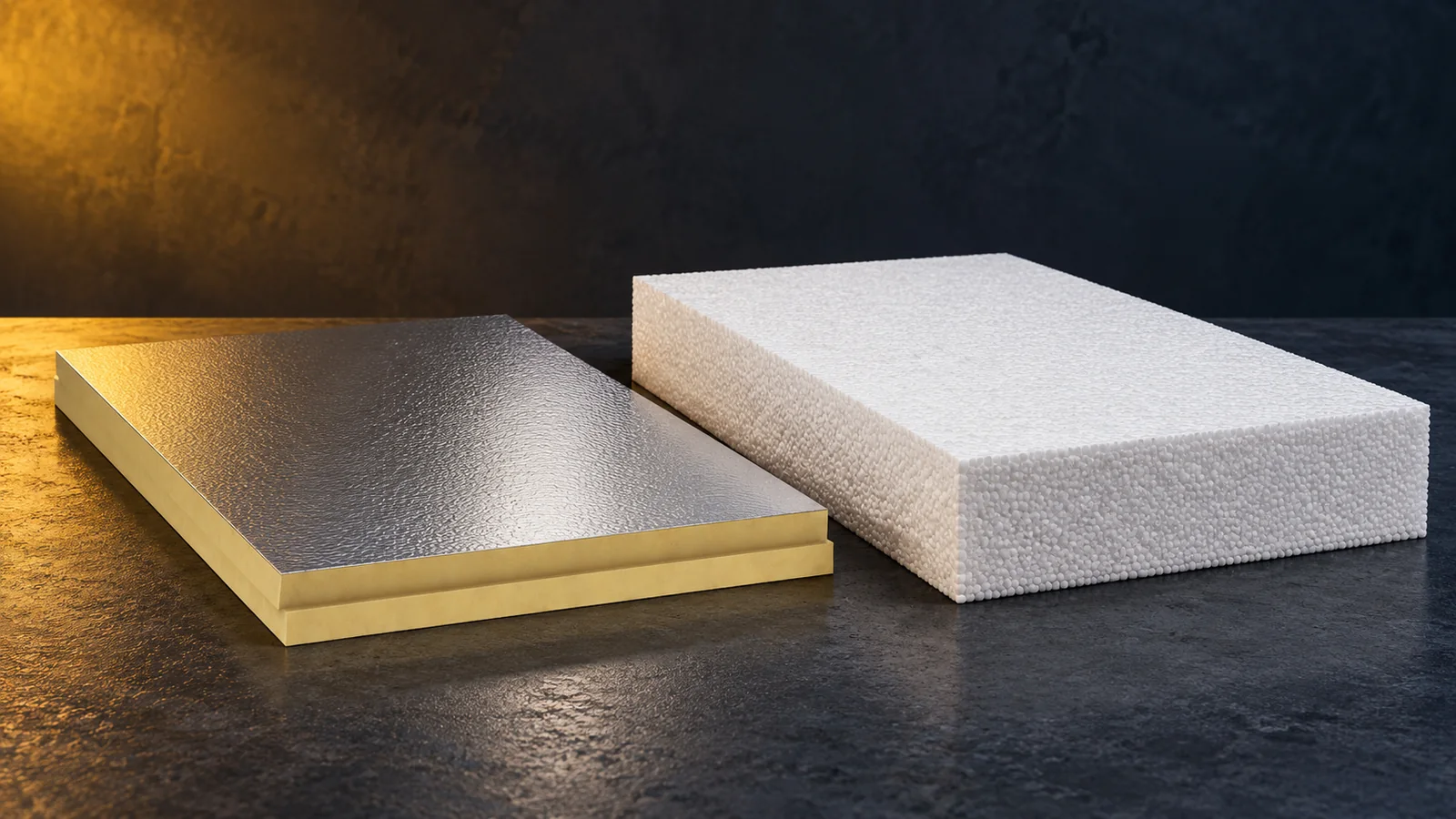
At the same thickness, good graphite EPS has a higher thermal resistance than EPS with a higher lambda. The thickness advantage of PIR may therefore be smaller than a general advertising slogan suggests. The figures below show layers with a resistance of approximately 4.55 m²K/W.
| Example material | Lambda W/(m·K) | Thickness |
|---|---|---|
| PIR | 0.022 | 100 mm |
| Graphite EPS | 0.031 | 141 mm |
| EPS | 0.036 | 164 mm |
The values are calculated. The commercially available thicknesses and the declared thermal resistance of a specific board must be checked before purchase.
The calculation can also be reversed. For 150 mm EPS with a lambda of 0.031, the equivalent PIR layer with a lambda of 0.022 is approximately 106 mm. In this case, a 100 mm PIR board will not achieve exactly the same resistance. If the selected PIR under render has a lambda of 0.025, the required thickness rises to approximately 121 mm. The type of facing and the properties of the specific product are therefore of practical importance.
With several layers, their resistances are added together. Two 50 mm boards can be thermally equivalent to 100 mm of material with the same lambda, but the joint layout and fixing method must be correct. It should not be assumed that additional air gaps between poorly fitted boards will increase the insulation performance.

Can every PIR be used instead of EPS?
Similar thermal resistance does not mean full interchangeability. On a rendered façade, a board approved for the given system is required. Typical PIR with a smooth aluminium foil is not automatically a substitute for façade EPS. The rules for bonding, fixing and finishing change.
In a floor, the mechanical properties and long-term loads must be compared. At foundations, moisture conditions are added. In every application, fire requirements are important. The class of the complete assembly must not be transferred to the core alone. Check the whole design before changing the material. The centimetres saved do not compensate for using a product where it was not intended.
Does a thinner layer mean a lower heating bill?
If two correctly constructed building components have a similar U-value, their losses through that section will be similar under the same conditions. The advantage of PIR then lies primarily in the smaller thickness. An identical percentage reduction in the bill cannot be derived from the centimetres saved.
Energy consumption is also influenced by ventilation, windows, thermal bridges, the building area and the heating method. Leaky connections can reduce the benefit of a good material. It is therefore worth assessing the details at ring beams, plinths and reveals. Thinner insulation is often particularly useful precisely where a thicker layer cannot be properly accommodated.
How to compare cost without making a mistake?
Request a quote for the same area and a similar thermal effect. Include the thickness of the complete system, fixings, adhesive, finishing and adjustments to window sills and flashings. PIR may be more expensive per metre of material but reduce the cost of some details. In a simple assembly, EPS may remain more economical.
When purchasing, check the resistance declared for the chosen thickness. The value in the table may reflect declaration and rounding rules. Do not attribute to a product the exact result of your own division if the documentation gives a different parameter. The comparative calculation serves to select a variant, and the order should refer to a specific product and its documents.
7 branches. Materials closer to your project.