How can you sensibly insulate a garage, outbuilding or summer house?
PIR insulation
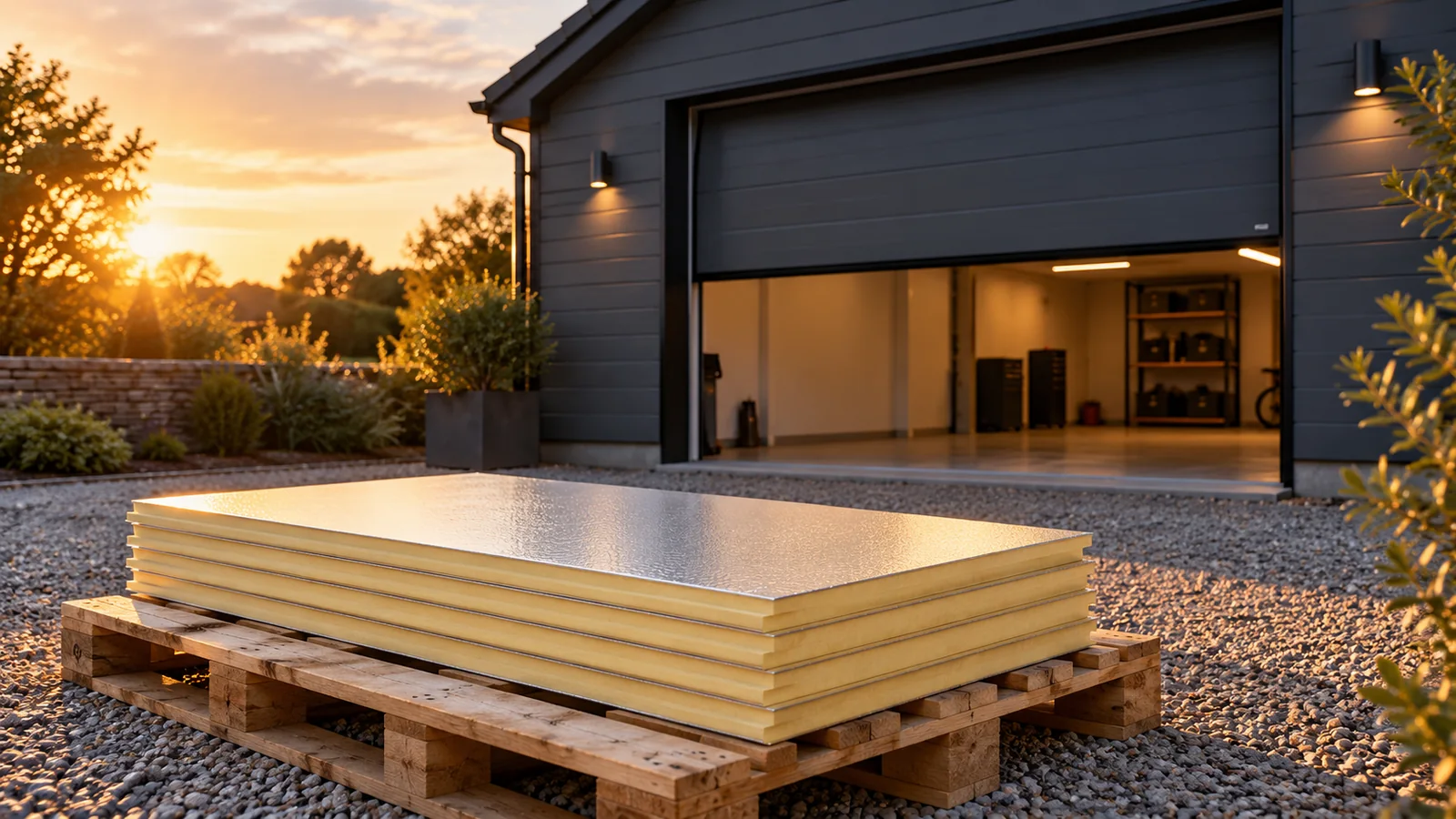
A garage, workshop and summer house each need a different approach to insulation. First you need to establish whether the building will be heated and how often it will be used. PIR achieves a good thermal resistance at a small thickness. In many renovations this is a major advantage. It does not, however, relieve you of repairing leaks, sorting out ventilation or checking the substrate and finish. An unheated garage is planned differently from a workshop where people work every day. In an unheated room, insulation slows the rate of temperature change. On its own, however, it will not guarantee a temperature above freezing during a long frost. You need a heat source or another realistic balance of gains and losses.
Does the building need to retain heat all year round?
An unheated garage is planned differently from a workshop where people work every day. In an unheated room, insulation slows the rate of temperature change. On its own, however, it will not ensure a positive temperature during a long frost. A heat source is needed, or another real balance of gains and losses.
In a cabin used in winter, airtightness, windows and the floor also matter. Insulating one section of the roof will not fix large losses through a leaky gate. Record the intended use. If a heated workshop is to be created in a year, it is better to allow for it now than to dismantle finished linings later.
In a summer cabin, also pay attention to summer. Insulation limits heat flow through the roof, but comfort also depends on sun entering through windows, shading and ventilation. Do not promise that a given PIR thickness alone will ensure a cool interior. In a building heated only at weekends, the heating-up time and the way humidity is maintained during absence matter. These differences are worth describing before choosing the material, because they affect the entire assembly of building elements.
Where does PIR give the greatest benefit?
A thin layer matters under a low ceiling, at a small eaves overhang and in narrow rooms. For example, 100 mm of PIR with a lambda of 0.022 W/(m·K) gives a resistance of about 4.55 m²K/W. For a material with a lambda of 0.036, a similar resistance requires about 164 mm. This comparison covers the layers alone, without thermal bridges and the rest of the construction.
The boards are rigid and can be adapted to flat surfaces. This does not mean that every type can be laid anywhere. For the floor, the correct mechanical parameters are needed. On a wall under plaster, a product intended for the façade system is necessary. A loft, in turn, requires a correct solution for moisture and joints.
What should you check before buying the material?
Start with the roof. Leaky flashings and leaks must be repaired before insulation. Then check the walls, the condition of the timber and the evenness of the substrate. If the wall is damp from the ground, adding a board from the inside will not remove the cause. In a lightweight building, it is also worth establishing whether the structure will carry the additional layers.
- Measure the areas and the lengths of the edges.
- Check the area around doors and windows.
- Determine the fixing method and finish.
- Plan the services before covering the walls.
This lets you compare complete solutions rather than just prices per square metre of insulation.

Can a garage simply be lined on the inside?
This possibility must be checked for the specific assembly. In a garage, water and snow are brought in and the door opens frequently. Temperature and humidity change quickly. A sealed PIR layer on the inside requires careful detailing of the joints and an assessment of how the existing wall behaves.
The foam should not remain unprotected where the system specifies a facing. Fire requirements and impact resistance matter. In a workshop, dust, sparks and services are added. The insulation should not be treated as a substrate for arbitrary shelf fixing. Loads must be transferred to the structure. When choosing the finish, also consider cleanability and repairability.
How to compare the cost of PIR and other insulations?
Compare materials at a similar thermal performance. A cheaper square metre of thicker insulation can be a good choice if there is room for it. EPS is often a sensible budget option. Mineral wool has advantages in assemblies with specific fire and acoustic requirements. XPS may be better suited to selected locations exposed to water and high pressure.
Add tapes, adhesive or fixings, facings and detailing of openings to the price of the board. In a small building, transport and the purchase of full packs matter a great deal. Present the same scope to the contractor for each variant. Only such a comparison will show what you are actually paying extra for and where thinner PIR saves additional work.
How to arrange the work in a sensible order?
First remove the sources of water and improve ventilation. Then take measurements and determine the details. Carry out the insulation installation on a dry substrate, with boards fitted and the joint layout specified in the instructions maintained. Gaps must be repaired with a material compatible with the system. It is not worth leaving them to be covered later with a trim.
Finally, check the finish and the junctions at the garage door, windows and ceiling. If the building is heated periodically, the ventilation method must be adapted to how it is used. Good insulation gives a predictable result when it covers the entire path of heat loss. Buying boards with the best lambda value alone will not replace this sequence.
7 branches. Materials closer to your project.